Chain Drive vs Gear Drive: A Practical Guide for Mechanical Transmission Design
In mechanical transmission system design, selecting the appropriate power transmission method directly affects system efficiency, reliability, cost, and maintenance requirements. Among the most common solutions, gear drives and chain drives are widely used across industrial machinery, conveyors, and power transmission equipment.
Understanding their differences helps engineers and buyers choose the right solution based on real operating conditions.
Gear Drive Transmission
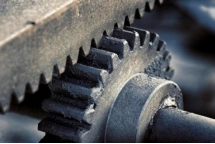
A gear drive transmits power through direct tooth engagement between meshing gears, providing precise and stable motion. Because the transmission ratio remains constant, gear drives are well suited for applications requiring accurate speed control and high rotational speed.
Gear drives offer high efficiency, strong load capacity, and compact structure, allowing significant torque transmission within limited space. With proper lubrication and alignment, they provide long service life and reliable performance.
However, gear drives are not suitable for long-distance transmission and require high manufacturing and installation precision, which increases cost. Noise and vibration may also occur, especially in high-speed or poorly lubricated systems.
Chain Drive Transmission
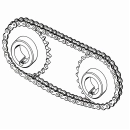
A chain drive transmits power through engagement between a chain and sprockets, with multiple teeth sharing the load. This design allows longer center distances and reliable power transfer without slipping.
Chain drives perform well in dusty, high-temperature, or harsh environments, making them common in conveyors, agricultural machinery, and industrial equipment. They are cost-effective, easier to manufacture, and simpler to install and replace.
The main limitations of chain drives include speed fluctuation caused by polygonal action, wear-related elongation, and the need for regular lubrication and maintenance. Chain drives are also mainly limited to parallel shaft configurations.
Chain Drive vs Gear Drive: Key Differences
| Comparison Factor | Gear Drive | Chain Drive |
| Transmission principle | Direct gear tooth meshing | Chain and sprocket engagement |
| Transmission distance | Short | Long |
| Transmission ratio | Constant and precise | Slight fluctuation |
| Load capacity | Very high | High |
| Speed capability | Suitable for high speed | Moderate speed |
| Environmental tolerance | Requires clean, enclosed system | Performs well in harsh conditions |
| Installation complexity | High precision required | Simple and flexible |
| Cost level | Higher | More cost-effective |
| Maintenance | Lubrication and alignment critical | Regular lubrication and inspection |
How to Choose the Right Solution
- Choose a gear drive when high precision, compact design, and stable speed control are required.
- Choose a chain drive when long transmission distance, cost efficiency, and environmental adaptability are more important.
There is no universal solution—the best choice depends on application requirements, operating environment, and lifecycle cost.