Short pitch precision roller chain (A series)
Short pitch precision roller chain designed for stable power transmission in industrial drive systems.
View More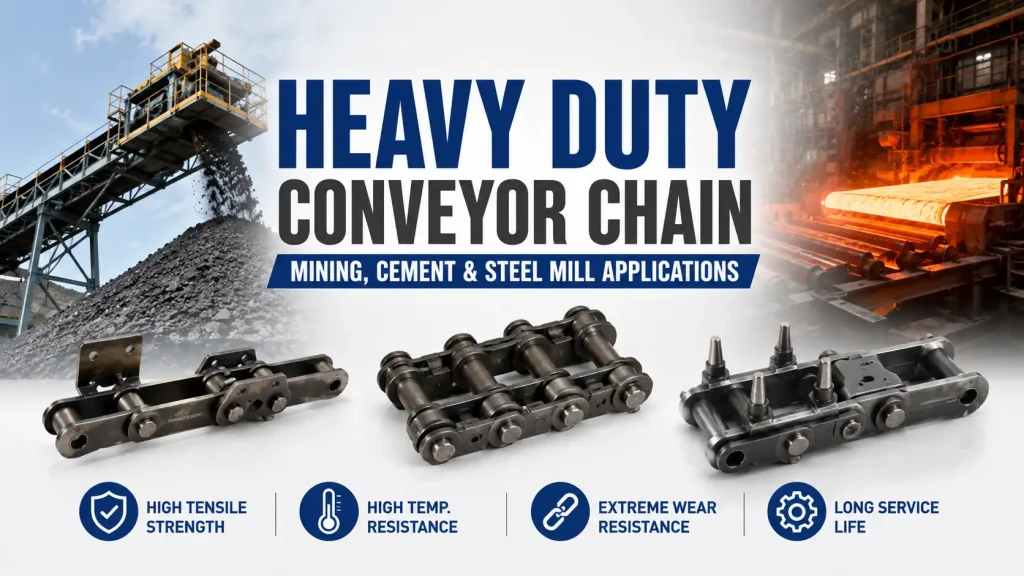
Heavy duty conveyor chains have to comply with ISO 1977 and DIN 8167 specifications to withstand loads more than 1200 kN and temperatures of above 800°C. High industrial applications need to be made from alloy steels with special heat treatments and deep case hardening for high resistance to extreme wear and shock impacts.
Universal Chain produces heavy duty conveyor chain systems designed specifically to satisfy these strict tensile strength and fatigue limit criteria. Backed by ISO 9001 certification and serving thousands of industrial clients worldwide, our chains deliver verified durability in harsh environments.
Heavy industry conveyor chains demand high-tensile strength, high fatigue resistance, and wear longevity in order to endure material conveyance continuously in mining, cement, and steel plants.
Heavy material handling environments put a lot of strain on power transmission components. Mining, cement works, and steel plants move large volumes of material around their facilities constantly. These machines operate in dusty, abrasive, and hot conditions.
The moving parts of the conveyor system used in these facilities experience continuous sliding friction as well as heavy tensile loads. The standard driving chains are quickly worn out in such conditions. Therefore, plant managers require engineered chains designed specifically for these severe services.
The operating costs could dramatically increase when breakdowns caused by chain failure happen. Thus, choosing the correct chain makes the operation much cheaper and minimizes downtime.
A conveyor chain for mining industry must resist abrasion and extreme loads as mining operations commonly move abrasive ores, granite, and overburden under severe impact loads. Tonnage requirements require chain breaking strengths commonly exceeding 1000 kilonewtons.
A drag chain conveyor mining system transports bulk materials directly through steel troughs. Bulk materials caught between various parts cause wear on pins and bushes. Hence, specialized forged steel chains are used to avoid early pin withdrawal and fatigue fracturing in shock loading conditions.
In an open pit copper mine, the primary apron feeder receives direct dumping load from haul trucks. The mining industry uses special heavy duty forged steel chains with induction-hardened pins. The chain components retain dimensional pitch stability in continuous 24-hour working conditions.
The large-scale manufacturers of iron ore (for example, Rio Tinto, BHP, and Fortescue) use apron feeders in which dump trucks unload large amounts of iron ore. Carbon steel chains wear out fast in such conditions (within 6 months at best). Therefore, upgrades like alloy 40Cr / 42CrMo chains with hardened pins (58-62 HRC) were used to achieve multi-year service lives.
A conveyor chain for cement plant must handle high temperature and dust environments as these processes handle limestone, hot clinkers, and other raw materials under extreme thermal and abrasive conditions. Clinker commonly leaves rotary kilns at temperatures exceeding 400 degree celsius.
A bucket elevator chain lifts the raw meal and the hot clinker into storage silos. Fine cement dust gets into the standard bearing gaps, thus forming abrasive paste which wears out the pins very quickly. Therefore, it is necessary to have a sealing system and proper heat treatment to be able to operate continuously.
Clinker pan conveyors need heat resistant alloy steels to avoid the thermal oxidation and elongation. In a hot environment, the strength of the steel is reduced dramatically. Specialized alloy compositions are then used to ensure the chain maintains mechanical integrity at elevated temperatures.
To learn more about clinker handling, read Universal Chain’s guide on heavy duty conveyor chains for cement plants.
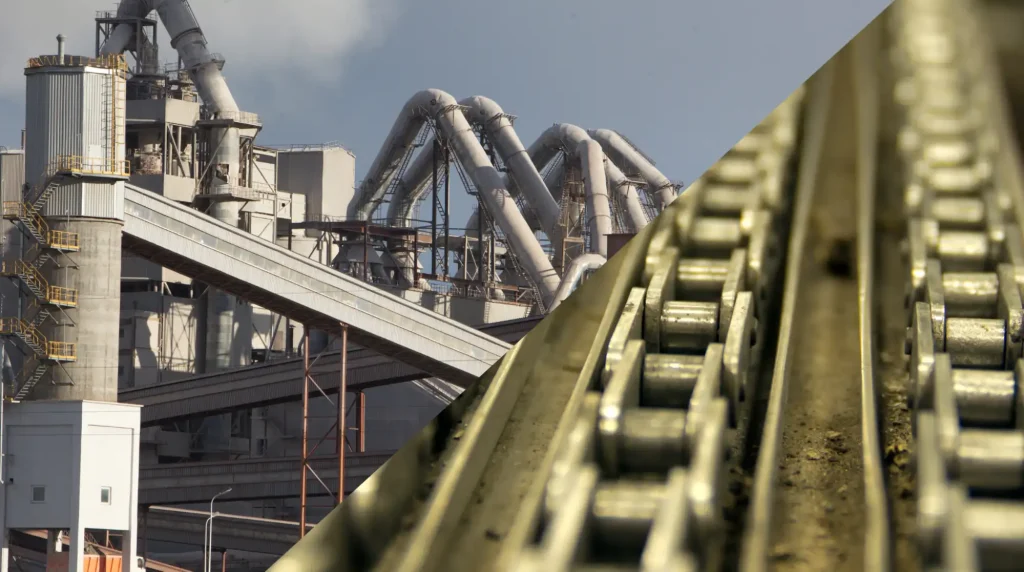
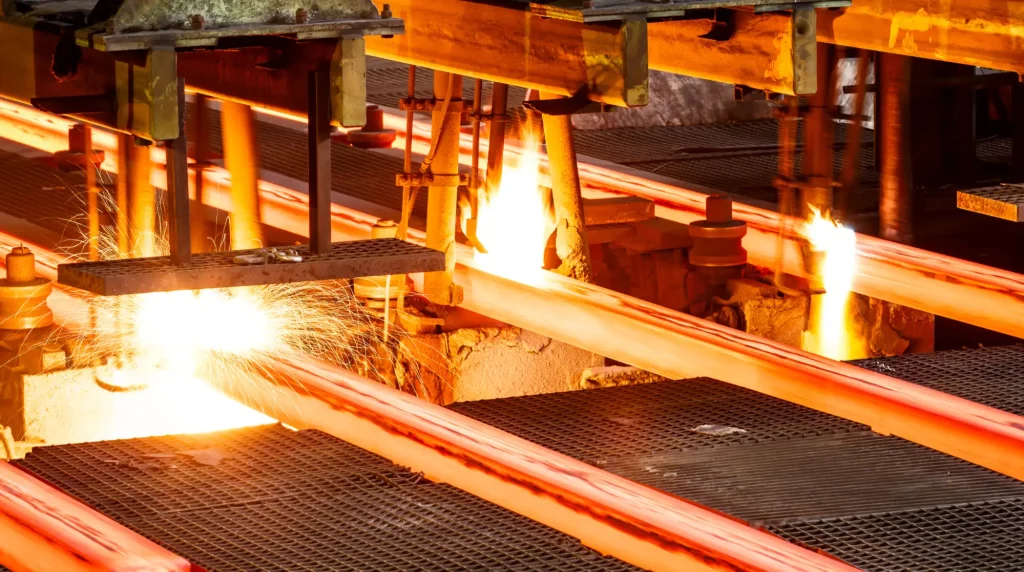
A conveyor chain for steel mill are built for heat, scale, and shock loads because they are meant to carry hot slabs, billets, coils, and scrap metal. Steel mills create a lot of heat, falling mill scale, and also mechanical shock. Their temperatures are often higher than 800°C close to the zones of furnace discharge environments.
Mill scale is an abrasive flake of iron oxide which falls into joints of the chain. Scale deposition results in chain joint locking, higher drive torque, and increased rate of wear of teeth of sprocket wheels. Structural forgings withstand constant load from heavy slabs without bending.
High temperature stainless or alloy steels are used in cooling bed conveyors and furnace feed chains. These materials do not scale, oxidize, and creep under cyclic heating. Proper lubrication channels provide access to high temperature synthetic greases to reach surface bearings.
| Chain Type | Design Characteristics | Primary Application | Key Advantage |
| Welded Steel Chain | Formed steel sidebars welded to curved barrels | Scraper & flight conveyors | High impact resistance & easy repair |
| Drop Forged Chain | Forked links forged from solid alloy steel | Drag chain conveyor mining | High tensile strength to weight ratio |
| Bucket Elevator Chain | Thick sidebars with precision ground pins/bushings | Vertical material elevation | High fatigue limit & wear life |
| Cast Combination Chain | Cast block links joined with steel sidebars | Intermediate bulk handling | Cost-effective in mild abrasion |
For additional details on chain selection, consult Universal Chain’s conveyor chain uses guide or review their analysis on what is bucket elevator chain.
The chemistry of the base material determines the basic mechanical properties. The medium carbon alloy steels, such as 40Cr, 20CrMnTi and 42CrMo are used in demanding industrial environments. Chromium and molybdenum increase the toughness and hardenability of the base metal.
Heat treatment changes the grain structure within the steel parts. The process of carburizing forms a hard case and ductile core at the same time. The induction hardening gives a hardness to the surfaces of the pins for wear resistance.
Surface treatments give additional protection from the environmental corrosion and chemical attacks. The processes of galvanizing, nickel plating, and special diffusion coatings protect the parts from rusting when stored outdoors.
Engineers calculate the total load based on the capacity of the conveyor, density of the material and friction coefficients to ensure that the right chain is selected.
The basic formula for total chain pull (T) on a horizontal conveyor is calculated as:
T = 2Wc+WmLfg
Where Wc is chain weight per meter (kg/m), Wm is material weight per meter (kg/m), L is conveyor length (m), f is friction coefficient, and g is gravity (9.81 m/s2).
Apply service factors (SF) for shock loads and environmental conditions. Calculate required minimum breaking load (MBL):
MBL = T SF
Service life depends on joint bearing pressure. Calculate maximum allowable bearing pressure (P) across pin and bushing contact areas:
P = TPin Diameter Bushing Width
The maintenance strategies for harsh environments include proactively checking on pitch elongation, chain replacement, sprocket alignment, and proper lubrication.
Proactive maintenance is necessary to avoid any chain failure in heavy-duty industrial facilities. Proper inspection will determine any pitch elongation without causing damage to the sprocket. Measure chain pitch across 10 links in order to determine percentage elongation.
Chain replacement is necessary once pitch elongation exceeds 3% of the original pitch size. Operating beyond 3% elongation results in chain jumping, causing serious damage to the sprocket teeth. Ensure sprocket alignment in order to avoid any sidebar wear.
Use of a proper lubrication system that fits in the operational temperature is important. Automatic oil drippers or grease systems apply lubricant directly to pin and bushing joints. Dry synthetic lubricants are used in dusty environments in order to avoid abrasive slurry formation.
The advantages of sourcing heavy-duty conveyor chains from China include cost savings, custom manufacturing, high production capacity, and consistent quality.
There is a considerable number of industrial power transmission products manufactured in China. Chinese factories, like Universal Chain, apply such technologies as automated forging lines, CNC machining and continuous heat treatment furnaces, which guarantee precise tolerances and quality standards.
Direct purchases from established manufacturers bring about substantial cost reductions without any decrease in quality. The best manufacturers can provide custom chain designs corresponding to OEM conveyor sizes. High capacities provide for fast deliveries even for urgent orders.
It is essential that overseas customers make sure that their supplier has proper quality and technological processes. Asking for material testing certificates, hardness certificates and dimensional inspection sheets proves compliance. Communication with factory engineers makes custom designing easier.
Short pitch precision roller chain designed for stable power transmission in industrial drive systems.
View More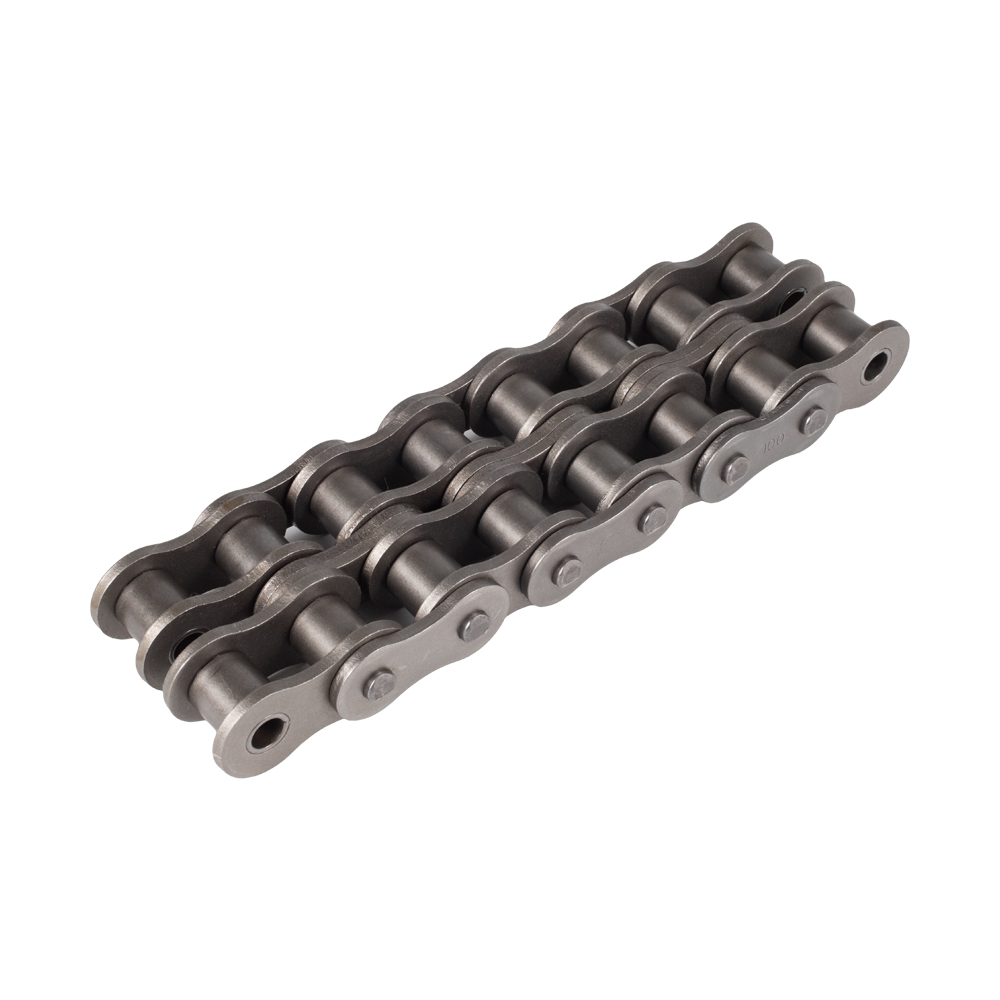
AI DETECTION (used app: https://copyleaks.com/ai-detector)
AI DETECTION (used app: https://gptzero.me/)

B2B CHECKER JUSTIFICATIONS (to debunk the validity of score)

✅ Both the primary and secondary keywords are present.
✅ Global standards and factory capabilities were mentioned in the article.
✅ No sentences exceed the 20-22 words. Take note that the GDocs word counter does not match with the B2B checker.
✅ The content, every after the headings, were written in NLP format.
✅ Photos were present as well.

PEOPLE ALSO ASK FOR FAQs