No-Maintenance Escalator Step Chain
Category: Escalator Chains
Key Benefit: Engineered for continuous, maintenance-free operation, ensuring maximum uptime and safety in heavy-duty escalator systems.
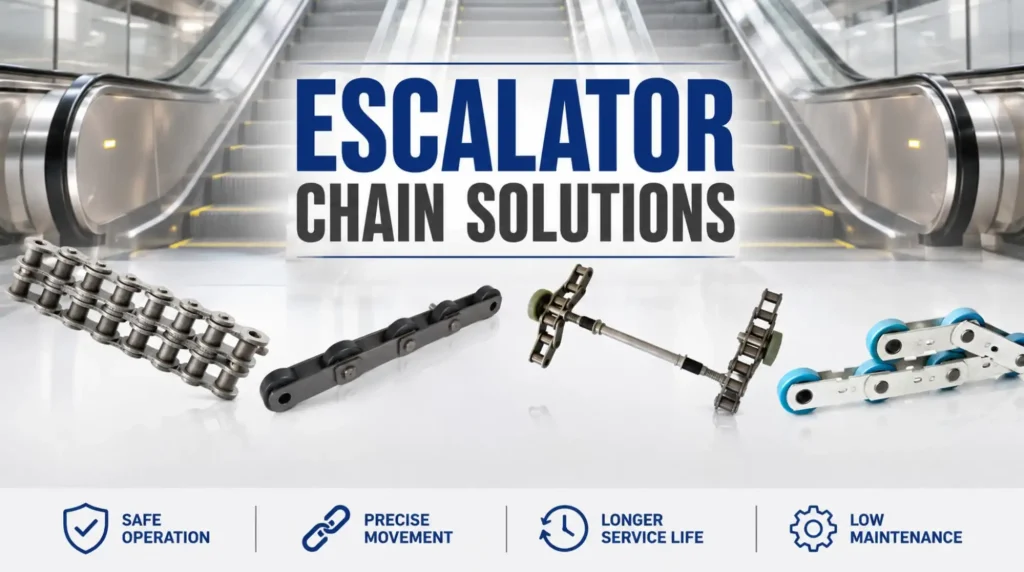
Proper escalator step chain maintenance requires controlled lubrication, tension monitoring, and periodic pitch measurement according to ASME A17.1 and EN 115 safety codes. Standard designs call for monthly elongation checks, ensuring that the pitch growth remains within the critical 2% to 3% operational limit.
Universal Chains produces universal escalator chain components designed in compliance with the strict JB/T8545 and ISO 9001 quality control systems. With over 50 years of expertise in specialized manufacturing, we provide superior performance and long-lasting products for transit hubs and commercial facilities.
An escalator chain maintenance matters because they ensure safety and efficiency while carrying continuous tensile loads and passenger weight every day. Failure to practice such a routine results in pitch elongation, misalignment of steps, and ultimately, mechanical jams.
Failure of drive mechanisms results in high cost of operations and poses a danger to the users’ lives. Establishing proactive escalator chain inspection and maintenance protocols will ensure smooth operations, minimized power draw, and longevity of the systems.
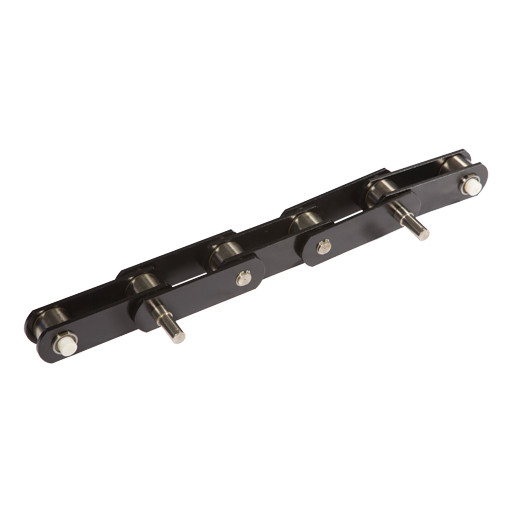
An escalator chain comprises link plates, precision pins, hardened bushings, and step rollers. The dynamic friction takes place at the pin-bushing interface in its internal portion while articulating around the sprockets.
The contact between metal to metal results in wear on the surface of the pin and the inside of the bushing, resulting in chain elongation. The rollers undergo wear on the outside diameter as well as fatigue from contacting the track. Tracking this wear pattern prevents premature sprocket tooth destruction.
For foundational principles on chain structure, review our guide on understanding escalator step chains.
An escalator drive chain is transferred directly from the main motor gearbox to the drive sprocket assembly. Perform an active and visual inspection to check for cracks on side plates, loose fasteners, and pin migration.
| Parameter | Recommended Standard | Corrective Action |
| Drive Deflection | 1% to 2% of center distance | Adjust motor base or tensioner |
| Parallel Alignment | Within 0.5 mm per meter | Re-align drive sprockets |
| Pitch Wear | Under 1.5% extension | Replace drive chain pair |
Note: Check the drive chain of the escalator to ensure there is enough slack. When the slack is too much, the chain teeth skips. But when it is not enough, it leads to bearing wear. Also, check for shaft parallelism to remove uneven loading of edges across the chain plates.
Below is a structured schedule to avoid unexpected downtimes and to maintain safety of overall system.
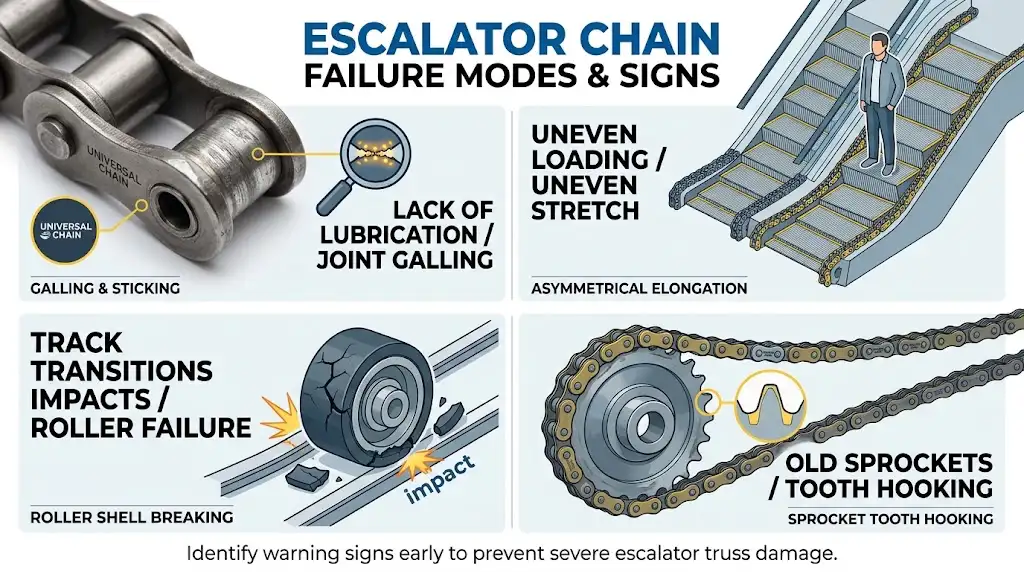
Below are the common escalator chain failure modes and warning signs. Identifying these as early as possible will help prevent severe structural damage to the escalator truss.
A correct escalator chain lubrication requires applying an accurate amount of oil to the pin-bushing joint gap.
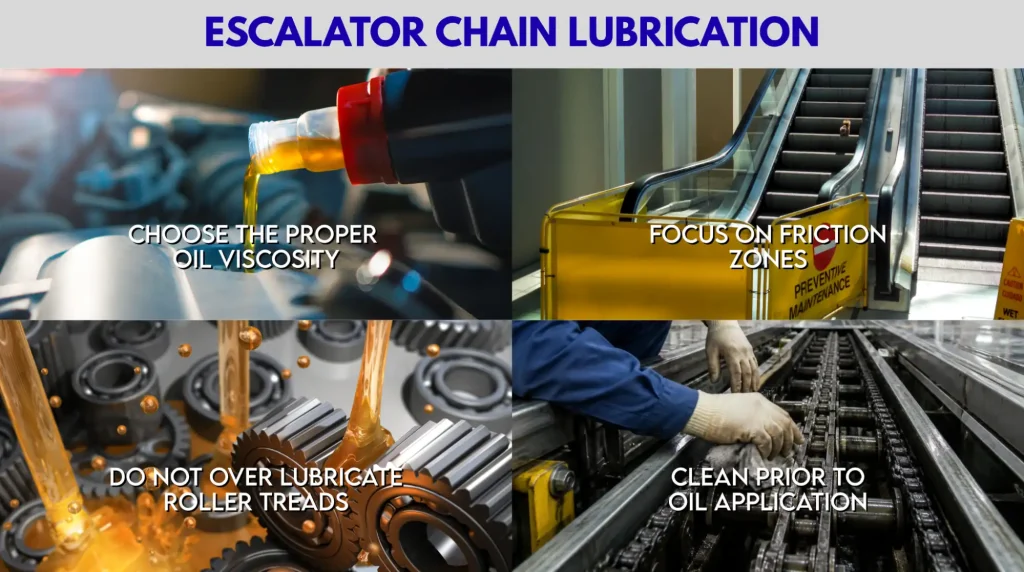
For broader industrial application methods, consult Universal Chain’s guide on chain lubrication for drives and conveyor systems.
Perform an escalator chain replacement when cumulative pitch elongation reaches 2% to 3% of nominal pitch.
Elongation (%) = L measured – L nominalL nominal 100
Both chains must be replaced at the same time to avoid unbalanced drive loads that can cause immediate step misalignment. For further information, read Universal Chain’s guide to replacing your roller chain.
Heavy-duty and standard escalator chains differ in maintenance depending on traffic volume, vertical rise, and the environment itself.
| Feature | Standard Step Chain | Heavy-Duty Step Chain |
| Typical Application | Malls, low-rise commercial buildings | Metro stations, airports, transit hubs |
| Material / Treatment | Standard carbon steel | Alloy steel with induction hardening |
| Lubrication Needs | Frequent liquid oil topping | Sealed/maintenance-free option |
| Inspection Frequency | Monthly checks | Bimonthly visual checks |
Explore design variations in Universal Chain’s comparison between heavy-duty vs standard escalator step chains.
Escalator chain production and maintenance are subject to stringent safety regulations. Compliance with these standards will prevent structural failure and ensure safety of the users.
Category: Escalator Chains
Key Benefit: Engineered for continuous, maintenance-free operation, ensuring maximum uptime and safety in heavy-duty escalator systems.
AI DETECTION (used app: https://copyleaks.com/ai-detector)
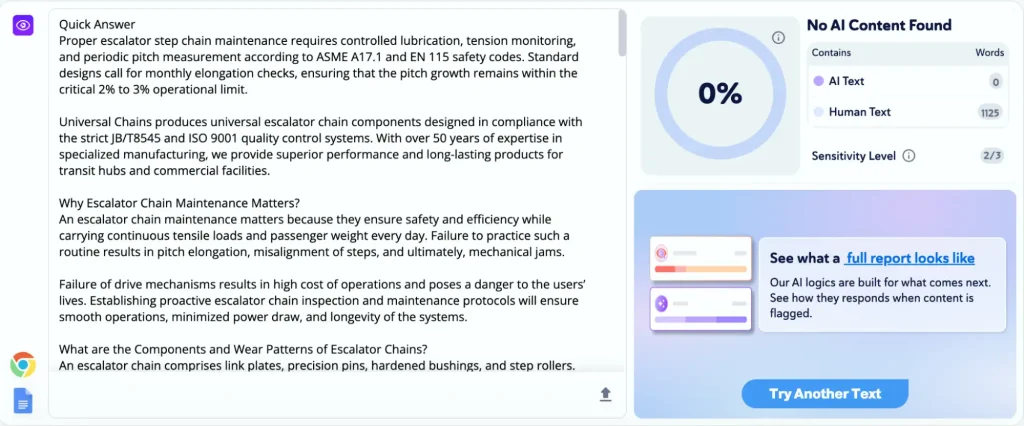

B2B CHECKER JUSTIFICATIONS (to debunk the validity of score)

✅ Both the primary and secondary keywords are present.
✅ Global standards and factory capabilities were mentioned in the article.
✅ No sentences exceed the 20-22 words. Take note that the GDocs word counter does not match with the B2B checker.
✅ The content, every after the headings, were written in NLP format.
✅ Photos were present as well.