How to Select Harvester Chains for Agricultural Equipment
Quick Answer: Select a harvester chain by identifying the machine station and its job first, then documenting the complete chain assembly, the mating hardware, and the field conditions that affect wear or operation. Treat a family listing as a starting point, not proof of fit. Universal Chains publishes combine, GS38, rice, corn, citrus, and soybean harvester chains within its agricultural-machinery chain range, and each proposed model should be reviewed against the exact machine and application before requesting a supplier quotation.
For roller chain agricultural machinery, this selection method turns those checks into a traceable RFQ package rather than a promise of machine fit.
Which harvester machine and chain duty are you specifying?
Start at the chain itself. Record the machine type, crop, model and variant shown on the plate, and the station where the chain operates. Then describe what it does. A compact drive is a different purchasing problem from an open conveying chain or an attached-flight assembly. The decision rule is location and duty before family name.
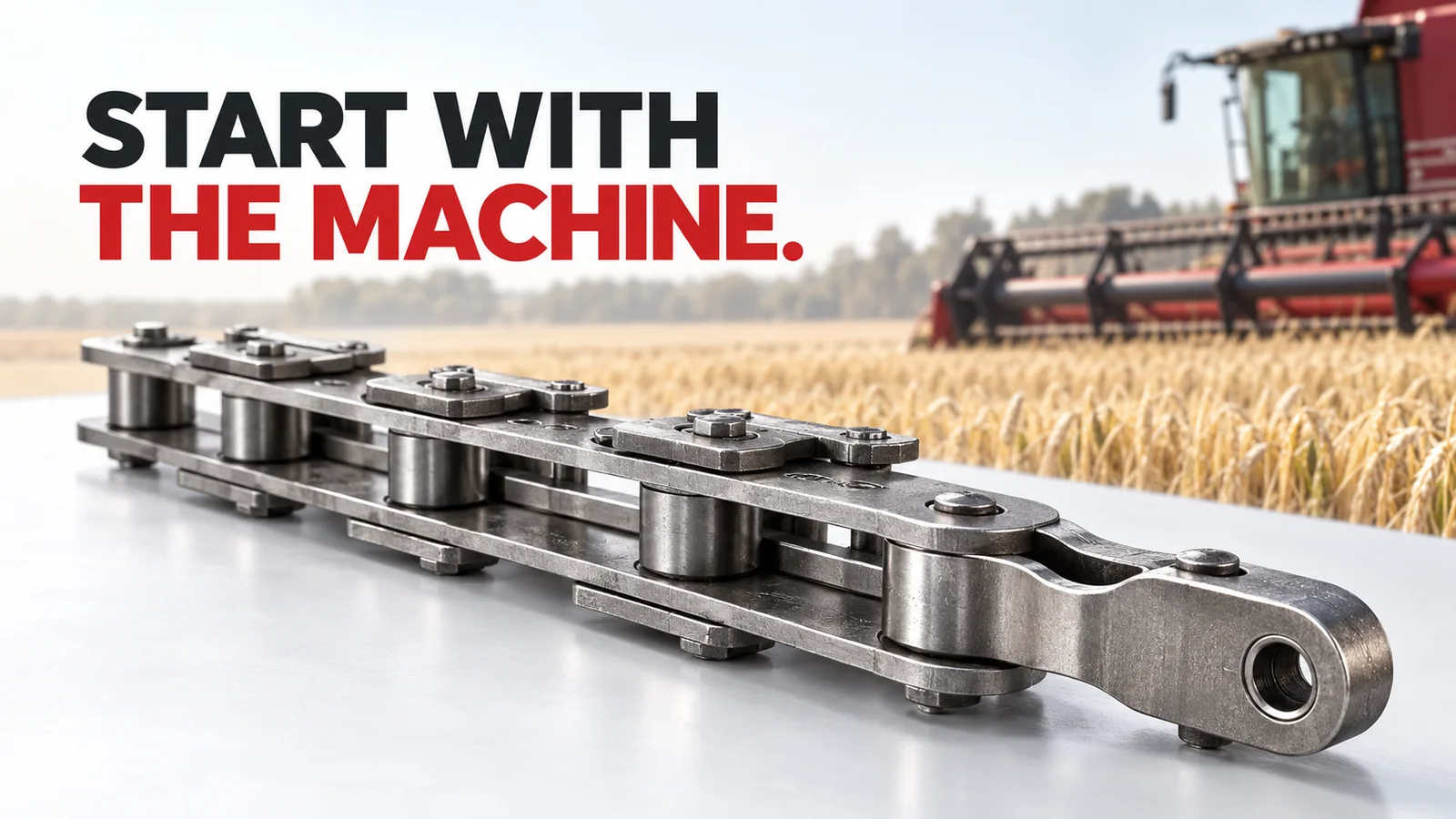
For a combine, distinguish the main transmission, elevator or conveying duty, and crop-gathering function. Universal’s combine harvester chain page identifies the family, but your machine and the chain’s task determine which questions matter. Its GS38 combine harvester chain listing associates that series with corn, wheat, and rice harvesting; that crop context still does not confirm a series-to-machine fit.
Crop should sharpen the duty description rather than become the whole specification. A rice harvester chain listing may prompt questions about moisture, mud, and residue. A corn harvester chain listing may prompt questions about stalks, leaves, and shock. Citrus and soybean pages frame their harvesting and conveying contexts. Use these family pages to guide the application review.
The station brief is ready when a technical reader can state the chain location, its task, and operating-area inputs.
Which chain construction and interface must match?
Do not assume that a short-pitch roller transmission chain can replace an agricultural attachment, feeder, or pintle-type assembly. Those labels describe different construction and interface questions. A technical selection guide separates compact roller drives from open detachable chain duty, but provides no universal cross-reference. Start with the Universal agricultural chains guide if you need terminology and component background.
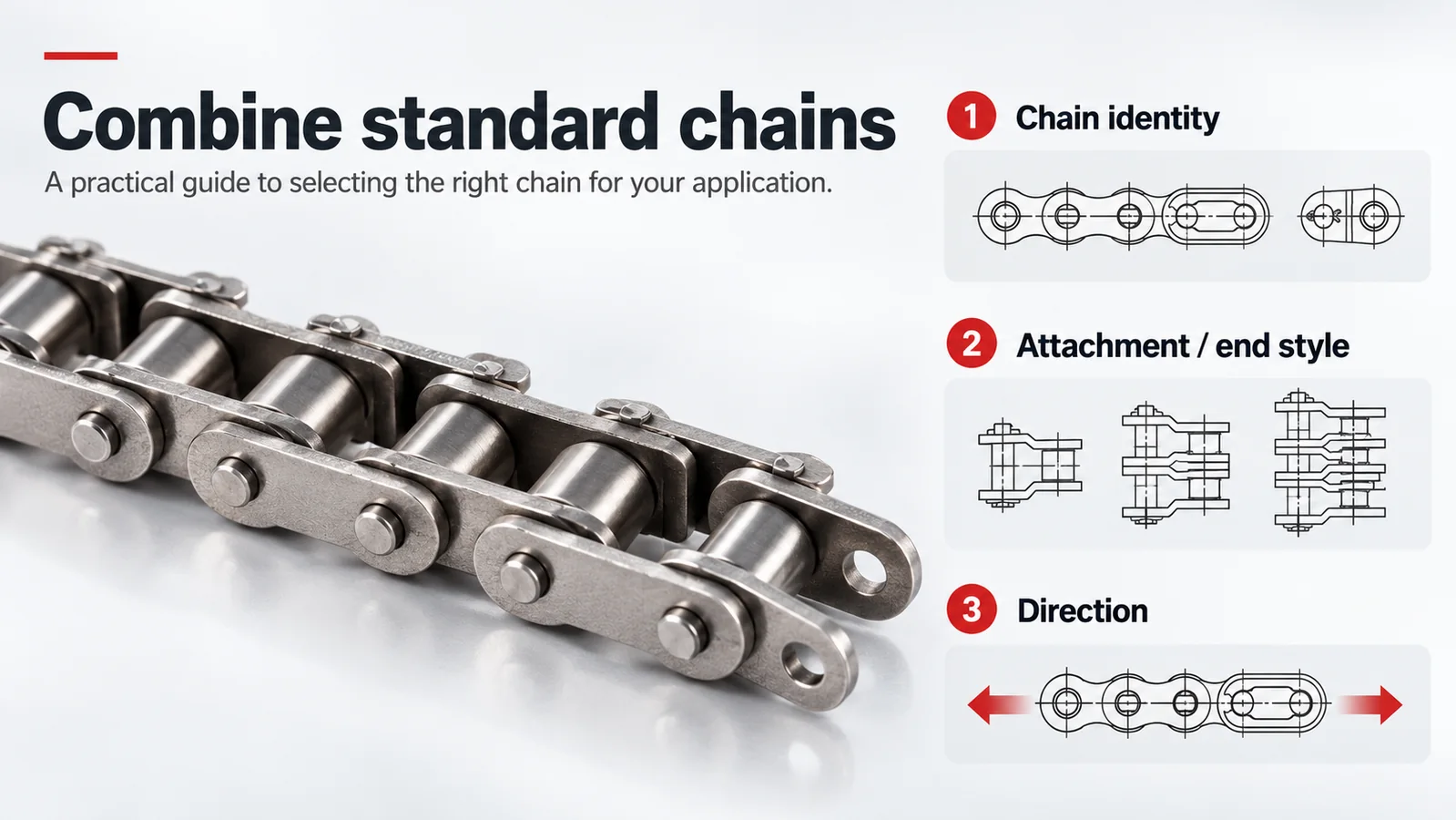
The replacement must engage the same sprockets, carry the same attachment layout, and fit the same available space. Record each item from the original assembly or a machine drawing:
| Buyer record | What to enter | Completion check |
|---|---|---|
| Machine and station | Make, model, variant, year, and chain location | A machine specialist can locate the station |
| Construction | Roller, detachable, pintle-type, feeder, crop-gathering, or attached-flight assembly, using the observed construction and markings | The label describes what is physically present |
| Pitch and strands | Pitch and strand count in millimeters and dimensions taken from the sample or drawing | Units and measurement points are stated |
| Roller and sprocket interface | Roller diameter, inner width, sprocket teeth, and engagement | The mating parts are documented together |
| Link and pin details | Plate and pin measurements, pin ends, and joining method | Source data and buyer measurements remain separate |
| Attachments | Type, pitch interval, orientation, flight geometry, and handedness | Direction and spacing match the drawing |
| Complete assembly | Guides, tensioner, housing, idler and drive sprockets, flights or paddles | The request describes the worn system, not a loose chain alone |
A family page, including a GS38 combine harvester chain listing, remains family-specific. A supplier comparison notes that dimensions can vary between manufacturers. Carry the source and measurement method for every value, and never fill a missing interface detail with a likely series name. The rice harvester chain page illustrates the limit: it lists 33 mm and 35 mm pitches for the 415 series it describes. Those values belong to that listing, not to every rice-machine chain.
What operating conditions should change the selection?
Describe the chain’s working environment, then let the supplier evaluate the design consequences.
- For crop residue and straw, state how chaff, stalks, fiber, or wrapping may collect around the chain and attachment area.
- For dirt and grit, identify dry dust, abrasive soil, and where material reaches the pins, rollers, guides, or sprockets.
- For mud, moisture, and washdown, state whether the chain sees wet soil, slurry, washing, condensation, or crop moisture.
- Record temperature during operation, cleaning, and storage.
- Identify fertilizer, crop chemicals, water, or other corrosion exposures that belong in the supplier’s material or coating review.
- Supply any available machine-maker load data, plus speed, starts and stops, reverse operation, incline, shock, and jam events.
- Document shaft alignment, guides, tensioner range, adjustment history, and uneven wear.
These observations do not set a universal chain type, lubrication schedule, tension value, or speed limit. The roller chain installation and maintenance guide provides general background; machine and chain-maker instructions govern the exact assembly.
Keep ultimate tensile strength, working load, fatigue demand, and wear demand distinct. Ask which value the supplier is using and how it relates to the proposed chain.
How should you match a replacement to the original assembly?
Before ordering, isolate the machine according to its shutdown, lockout, and stored-energy instructions. Do not remove, adjust, tension, or test a chain without the machine maker’s procedure.
- Locate and label the station. Match the chain to its drive, return run, conveying path, and adjustable components.
- Clean an accessible sample without destroying evidence. Remove loose material safely; leave wear surfaces, markings, and deformation visible for photographs.
- Record identity data. Copy machine-plate, drawing, approved-parts, and legible chain data, labeling each source.
- Measure the interface. Record the required pitch, strand, roller, plate, pin, and link details. State the measuring method.
- Inspect the whole assembly. Check attachments, flights, drive and idler sprockets, guides, tensioner condition, alignment, and abnormal marks that may explain the failure.
- Trace the failure history. Note reliable service hours, jam, overload, cleaning, adjustment, and replacement events. A passing inspection does not prove the whole machine is safe or ready for operation.
- Preserve the evidence path. Keep photos, drawing numbers, machine details, measurement notes, and the reason for rejection of each unsuccessful candidate.
The agricultural chains guide can help name components. Use the maintenance guide for general preparation, then follow maker procedures for removal and installation.
The combine harvester chain example shows why the whole assembly belongs in the dossier: a combine elevator guide describes chain, paddles or flights, sprockets, housing, and tensioning as one system. A request naming only “elevator chain” leaves the supplier to guess.
What should a harvester-chain RFQ include?
Give the reviewer enough information to answer two questions: what chain is requested, and what must be confirmed before the proposal is treated as a technical fit?
| Weak request | Stronger request |
|---|---|
| “Replacement chain for a combine.” | “Replacement for the grain-elevator station on [machine details]; assembly drawing and worn-sample photos attached.” |
| “Need the corn chain.” | “Corn-harvest gathering duty with the observed model or drawing details, listed attachment interval, sprocket details, and operating-condition notes attached.” |
| A series name with no measurements. | The proposed series, measurements, drawings, and a request to verify pitch, strands, attachments, and sprocket engagement. |
| “Quantity: one.” | “Initial quantity: one complete assembly; estimated annual requirement: [buyer entry].” No MOQ is assumed. |
| “Please send a price quickly.” | “Requested quotation date: [buyer entry]; requested delivery date: [buyer entry]; destination and Incoterms: [buyer entry].” No stock or lead time is assumed. |
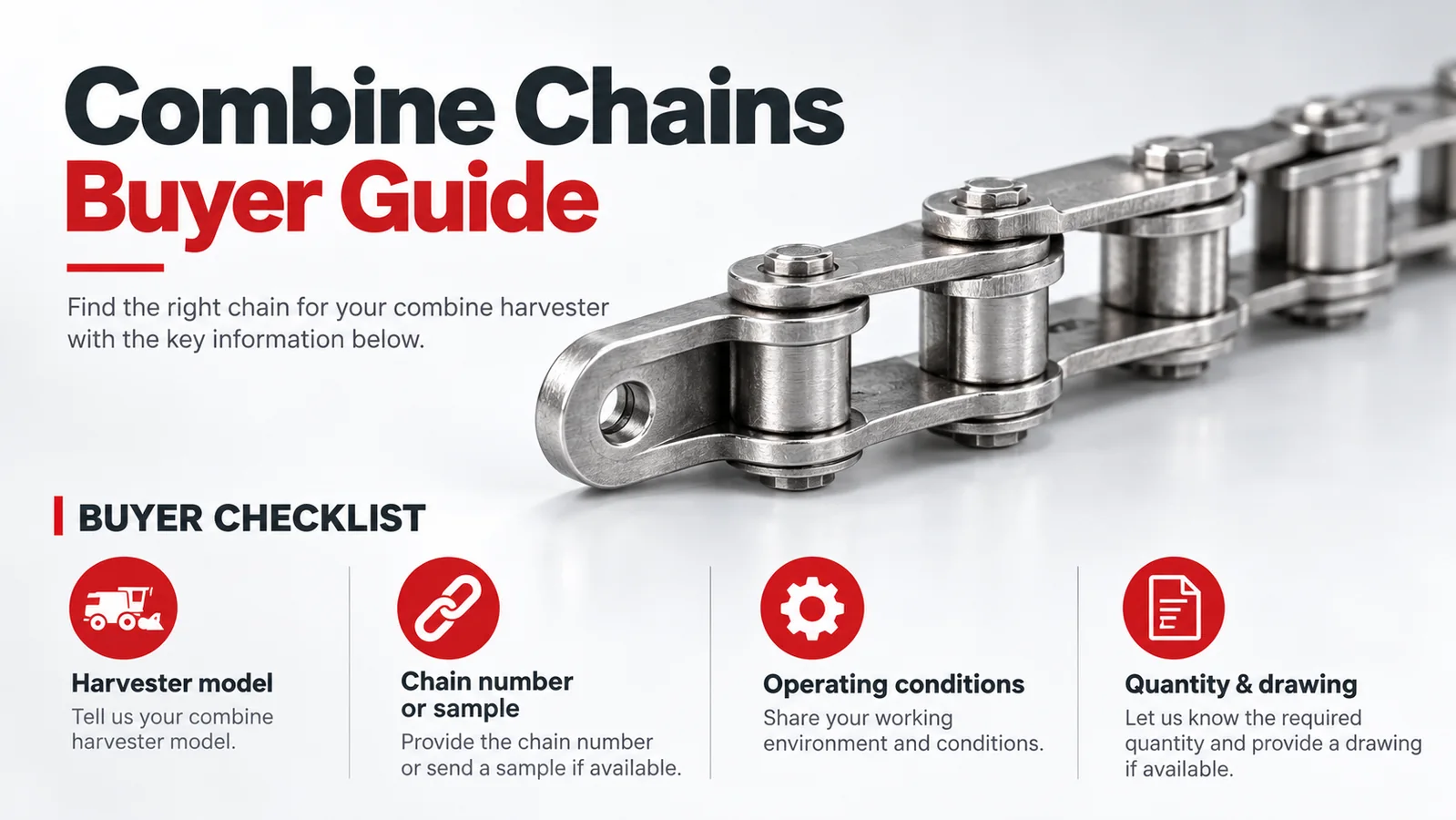
Use this RFQ checklist:
- Machine make, model, variant, year, and chain station
- Crop, chain duty, operating hours, duty cycle, and failure history
- Photographs and a drawing or marked-up layout of the complete assembly
- Chain construction, pitch, strand count, roller and pin details, attachments, and orientation
- Sprocket, guide, housing, and tensioner details
- Cleaning, moisture, contamination, temperature, storage, load, speed, shock, reversal, and alignment observations
- Initial quantity, annual requirement, destination, requested documents, required delivery date, and commercial terms
- Candidate series or part data, with each source clearly identified
- A written list of items the buyer cannot measure or the machine maker has not supplied
- An explicit request for the supplier to confirm assumptions and return a marked fit review
Keep buyer observations, machine-maker data, and chain-maker data separate. If a drawing, measurement, or limit is missing, say so and ask whom the supplier needs to contact. That makes the RFQ a reviewable document instead of a catalog guess.
Ready for a fit review? Send Universal Chains the machine and application details, chain identification or assembly drawing, duty and quantity, operating conditions, destination, and requested delivery date through the contact page. The review can then begin with the machine station and chain task rather than an assumed model match.