Leaf chain(AL series)
AL leaf chain is a light load series, mainly used in manual hydraulic forklifts, small tonnage electric forklifts and small tonnage diesel forklifts.
View More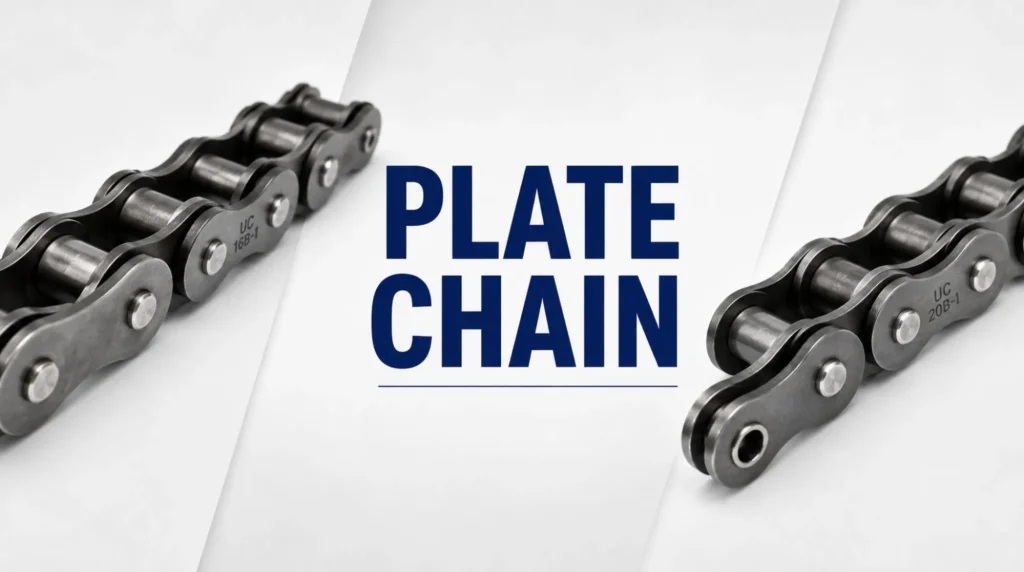
A plate chain consists of high-tensile-link chains designed for heavy mechanical stress, direct axial loads, and continual heavy lifting in a linear direction. These components are designed to standards according to DIN 8187/8188 and ISO 606 specifications, and their tensile strength capability is more than 1,000 kN.
The Universal Chain provides industrial plate chain options that are designed to exact international requirements of loads and tolerances. As a company, we hold ISO 9001 accreditation and can support more than 1,000 OEMs worldwide. We ensure that our production lines maintain a maximum fatigue life in extreme operating environments.
Plate chain is an industrial chain assembly made up of steel plates linked together through accurately ground load pins.
This is different from the power transmission chains because it uses interlocking of link plates to evenly distribute the tensile load throughout the chain. There are no bushings and rolling elements in the assembly; instead, there is a full metal cross section to handle the tensile load.
These chains are usually designed by engineers for use in heavy-duty tension applications like lifting and counter balancing. They are used in places where the machinery experiences constant strain. Through proper design and heat treatment of the alloy, an assembly is obtained that can withstand constant stress without permanent deformation.
Although plate chains and leaf chains share similarities in stacking plates over joint pins, the dynamics performance behavior and design of each are different:
A heavy duty plate chain uses hardened profiles of links for repeated cycles through sprockets or track guides. Leaf chains (AL, BL or LL type), on the other hand, are tension-driven linkage chains designed to cycle through sheaves and not tooth-driven sprockets.
| Mechanical Feature | Heavy-Duty Plate Chain | Leaf Chain (AL/BL/LL Series) |
| Primary Motion | Continuous conveying or linear driving | Reciprocating tension / vertical hoist |
| Engagement Interface | Drive sprockets or flat tracks | Smooth sheaves or guide drums |
| Internal Components | Link plates, pins, optional bushings | Alternating stacked link plates and pins only |
| Fatigue Optimization | Dynamic continuous cycling fatigue | High static tensile load & shock resistance |
If you have a rotary sprocket-driven setup for conveying bulk materials and/or moving machine parts, use a special conveyor plate chain and not a non-articulated leaf chain.
Choosing the right plate-type chain involves determining the mechanical forces, operating condition, and drive system that is involved with your equipment. The common types of plate chains include the following:
These chains are used in construction machinery mainly for heavy equipment to help them handle extreme strain. Their key applications in construction machinery include:
Telescopic crawler cranes and hydraulic boom systems employ highly tensile linkages for raising and lowering multi-ton loads by extending or retracting the boom sections. The elongation rate of such chains needs to remain minimal under extreme strain to ensure operator accuracy.
Excavators and continuous trenchers are subjected to shock loading and harsh abrasive working conditions. These chains are employed for transferring torque into digging teeth continuously while enduring high strain due to the impact of rocks without experiencing pin shear.
For further information about the different designs of trencher chains, refer to Universal Chain’s detailed guide on what is a trencher chain.
Special heat treated drag link chains are used in paver feeder systems for the movement of hot asphalt on the deck of the machine. The link plates resist thermal expansion and maintain dimensional stability at temperatures exceeding 180°C.
Selecting an industrial chain means determining the right mechanical characteristics.
This parameter shows the distance between joint pin centers. The industrial chain comes in pitches that vary between 12.7 mm (0.5 inch) to 101.6 mm (4.0 inches). Larger pitch values increase tensile capacity but require larger drive sheaves or sprockets.
UTS represents the maximal static force a chain is able to withstand without failing structurally. High load capacities mean tensile ratings of 50-1,500 kN, depending on plate thickness and lacing tightness.
High precision manufacturing and quality standard plays a vital role in the lifespan and fatigue resistance of the chain.
Top companies, like Universal Chain, follow ISO 9001 quality standards and international dimensioning standards such as DIN 8187/8188 and ISO 606.
Maintenance and inspection ensures longevity by preventing excessive wear, pin scoring, and untimely machine breakdown.
Regularly measure the amount of chain elongation in a 10-to-20 pitch span with a high accuracy caliper. Replace any chain where the elongation exceeds 2% as this results in poor sprocket meshing and uneven load distribution.
Lubrication will help you avoid metal-to-metal wear of pins inside plate holes. For more information about oil selection and application on lifting machinery, see Universal Chain’s leaf chain lubrication article for forklifts and lifting devices.
For more general material handling applications, see the company’s comprehensive conveyor chain uses guide.
AL leaf chain is a light load series, mainly used in manual hydraulic forklifts, small tonnage electric forklifts and small tonnage diesel forklifts.
View More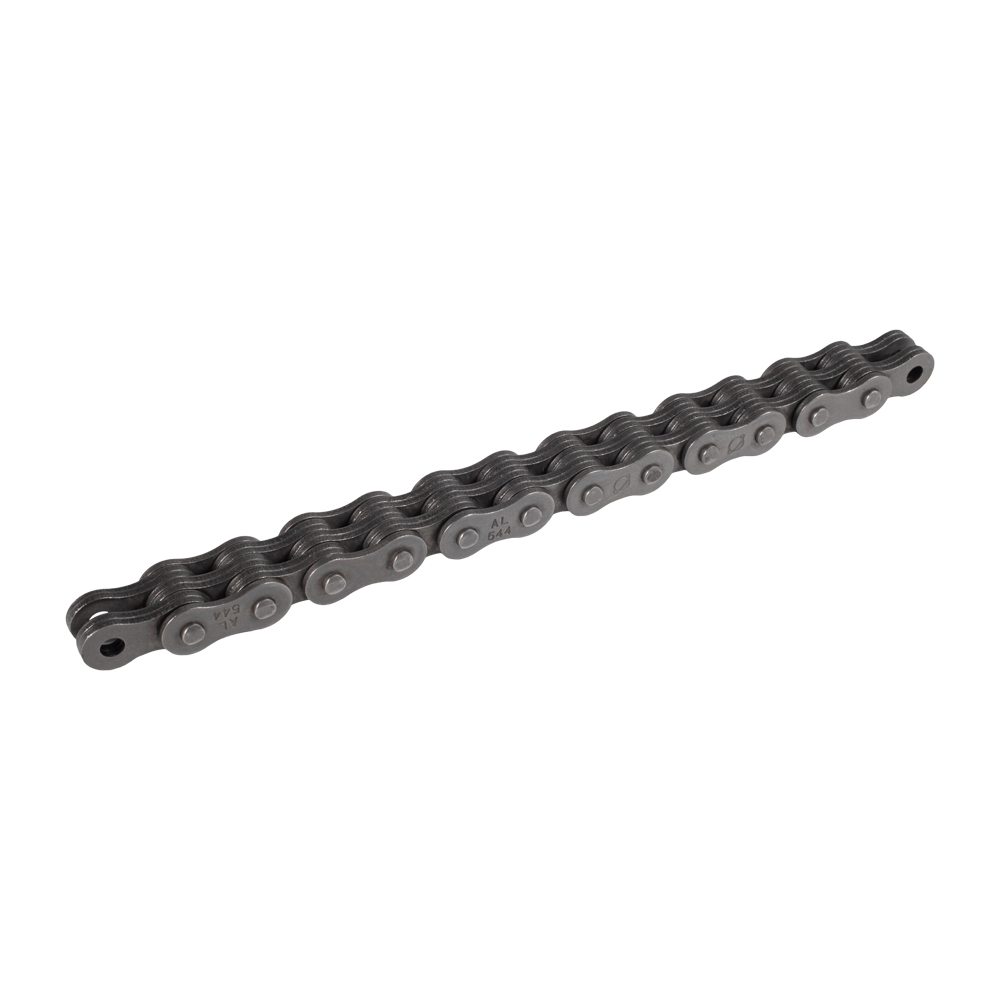
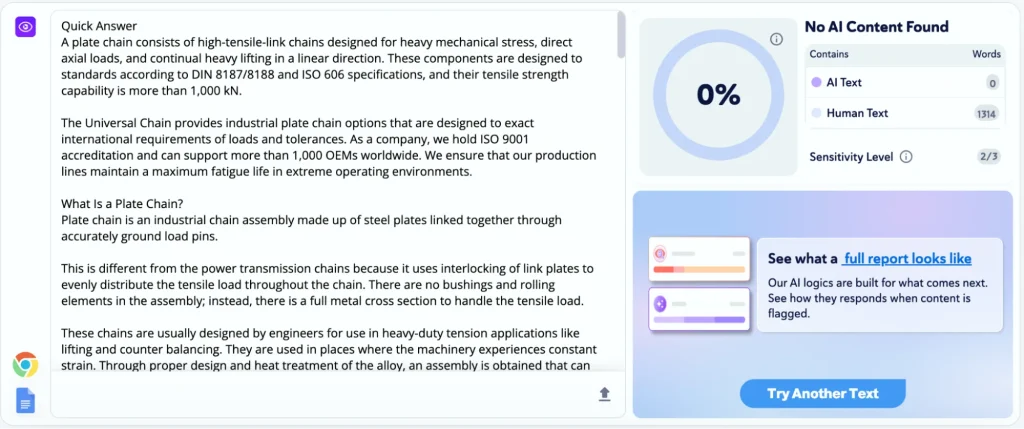
AI DETECTION (used app: https://copyleaks.com/ai-detector)
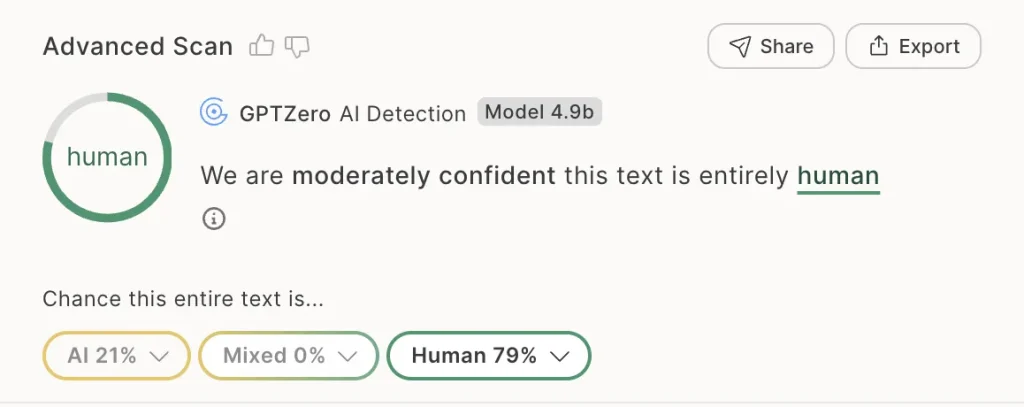
AI DETECTION (used app: https://gptzero.me/)
B2B CHECKER JUSTIFICATIONS (to debunk the validity of score)
✅ Both the primary and secondary keywords are present.
✅ Global standards and factory capabilities were mentioned in the article.
✅ No sentences exceed the 20-22 words. Take note that the GDocs word counter does not match with the B2B checker.
✅ The content, every after the headings, were written in NLP format.
✅ Photos were present as well.