Roller Chain Master Links: Types, Fit, and Installation
Quick Answer: Match an industrial roller chain master link to the exact standard, series, size, pitch, roller diameter, inner width and strand count, then select the connecting style the drive accepts. Spring-clip links are removable; riveted or cottered links require different tools. Lock out the drive, place a spring clip’s closed end toward travel, and verify seating, alignment, tension and free movement. Universal Chains lists A- and B-series precision roller chain and offers direct factory inquiry; exact master-link fit still requires the chain number or drawing.
A buyer should turn the replacement request into a precise assembly description for the drive-chain family, then install the correctly identified link through the procedure for its connector type.
What does a roller chain master link connect?
A roller chain master link joins two chain ends to form a loop around its sprockets, the toothed wheels that engage the chain. “Master link” is a general name for a connecting link, not one construction. Spring-clip, riveted, cottered and spring-pin designs can each join chain ends, but their plates, pins and fasteners are not interchangeable.
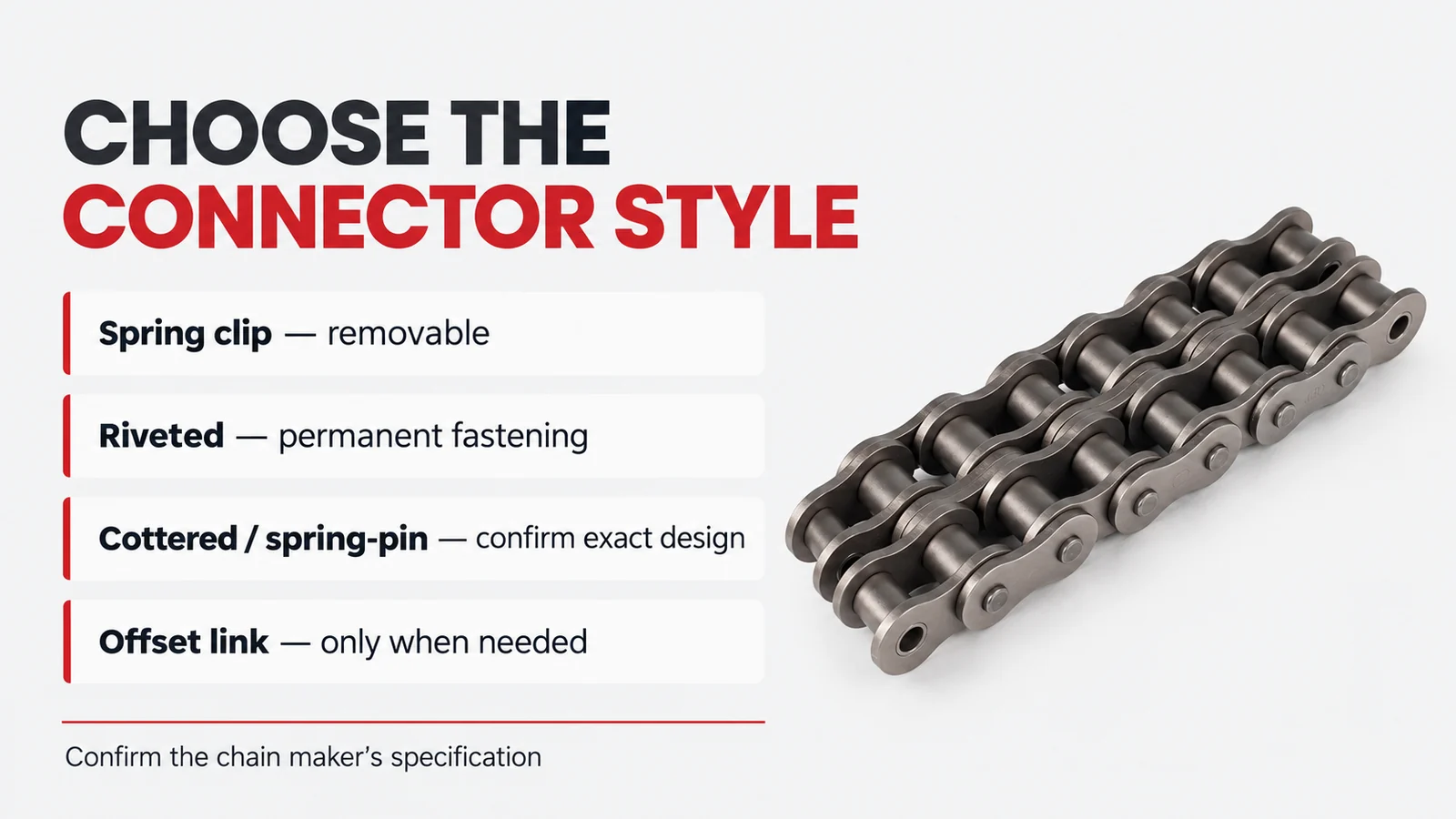
The master link becomes part of the load path. Its plates must fit the chain, its pins must enter the correct holes, and its retaining method must remain secure. Start with the precision roller-chain family, then use series and dimensions together.
Universal’s link-code terminology distinguishes a standard connecting link, a cotter-pin link and an offset link. Those codes help describe a request, but a code does not by itself prove that a connector is available for every size or that it matches another manufacturer’s chain.
Which master-link style fits an industrial drive?
Use the construction specified for the chain and application. A removable link can suit planned maintenance; a permanent fastening may be specified for the design. Do not choose by convenience alone.
| Style | How the parts are retained | Practical buyer check |
|---|---|---|
| Spring clip | A cover plate is held by a spring clip seated in pin grooves | Correct plate fit, clip seating and chain-travel orientation |
| Riveted | A press-fit plate is installed and the pin ends are riveted or peened | Approved riveting tools, correct pin ends, drawing and inspection |
| Cottered or spring-pin | The pin is secured by the construction’s cotter or spring-pin method | Exact fastener, pin, plate and assembly instructions |
| Offset link | Changes an odd-length assembly rather than acting as an ordinary master link | Whether an offset is necessary and what strength or fatigue limit applies |
Tsubaki’s connecting-link guidance describes spring-clip, cotter-pin and spring-pin designs across its own range. Those definitions explain the choices; they do not establish a Universal part or a cross-brand substitution.
An offset link deserves separate treatment. Tsubaki prefers an even number of links and distinguishes its offset types by load and fatigue tradeoffs when an odd number cannot be avoided. First see whether the chain length can avoid one; otherwise request the approved construction.
Universal lists A-series precision roller chain and B-series precision roller chain, and its FAQ says their sprocket structures make A and B series non-interchangeable. Do not treat a connector as suitable without that series context.
How do you match the link to the chain series and dimensions?
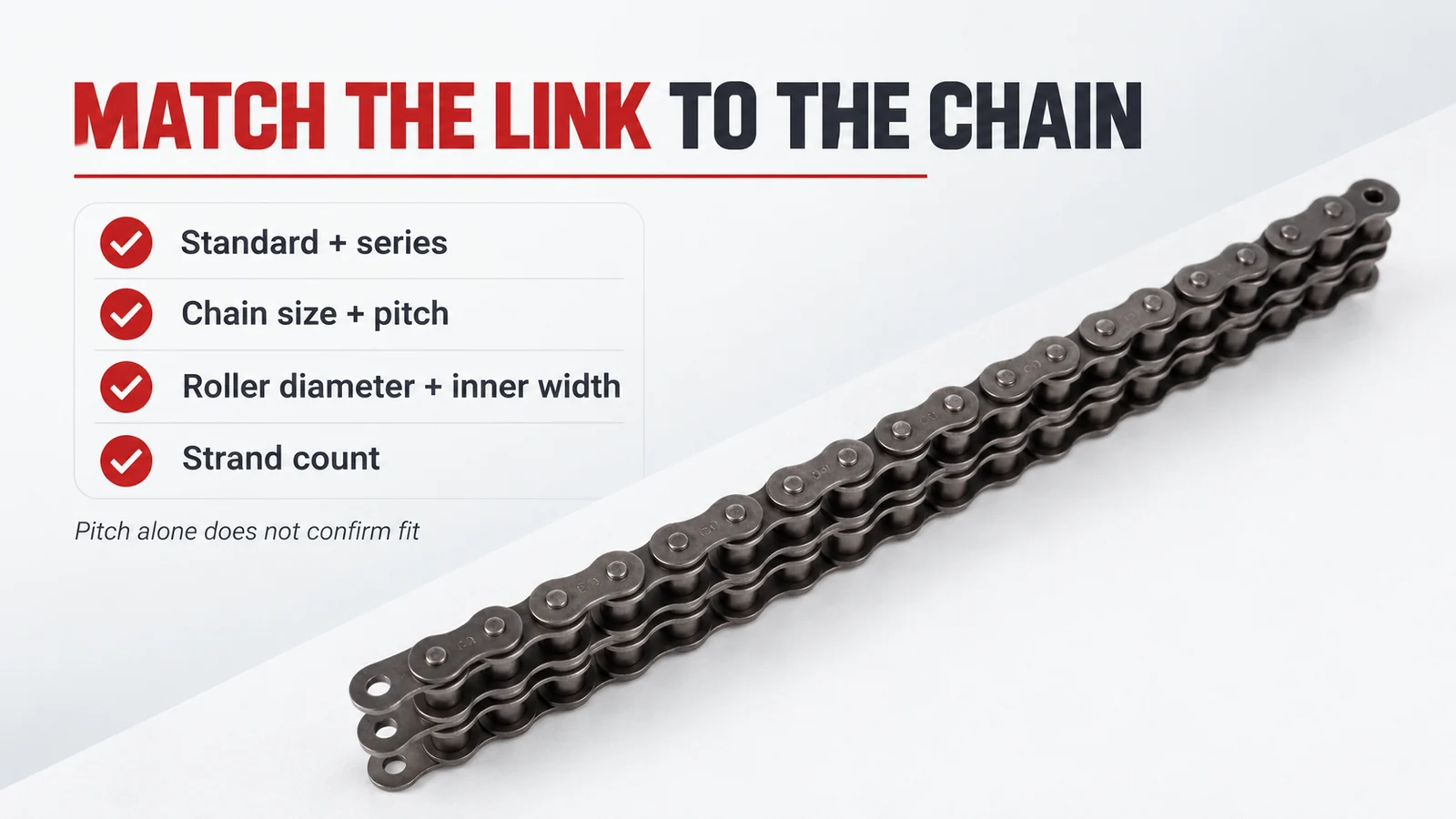
Confirm more than the chain number. A usable request names the standard and series, chain size, pitch, roller diameter, inner width, strand count, pin and plate dimensions, and preferred connection style. Pitch is the distance between adjacent pin centers; roller diameter and inner width define the other core interfaces.
The ANSI roller-chain dimensions guide shows why those fields belong together. Universal’s separate #40 versus #41 guide reports the same 0.500-inch pitch for both sizes but different inner widths. For a #40 roller chain master link search, treat #40 as a starting point rather than the complete replacement specification.
Use the roller-chain measurement guide to prepare dimensions from a straight section. For a modified, worn or unidentified chain, send a dimensioned drawing with photographs. The ANSI numbering overview explains the numbering system more broadly.
Strand count changes the assembly. Use the single- versus double-strand guide for more than one row of rollers. Pitch equality alone does not establish interchangeable plates, sprocket engagement or connector fit.
How should roller chain master link installation proceed?
Start by isolating the drive and confirming the connector. Shut off and lock out power, secure the equipment against movement, support the chain, and follow the site procedure for safely releasing any stored tension. Use the protective equipment and tools required by the site and equipment manual. Diamond’s industrial assembly guidance also warns against using a chain tool to support total chain weight.
Before fitting, inspect the chain ends and sprockets, align the sprockets, and confirm that the chain is not twisted. Check that the replacement matches the selected A-series or B-series specification where applicable. The wider installation and maintenance guide covers the sequence; machine or chain-maker instructions control the method.
For a spring-clip link, follow the plate order shown for that connector. Place the clip’s closed, solid end toward chain travel and confirm that it seats in both pin grooves. After assembly, check both plates, pin engagement, clip seating and free articulation without binding.
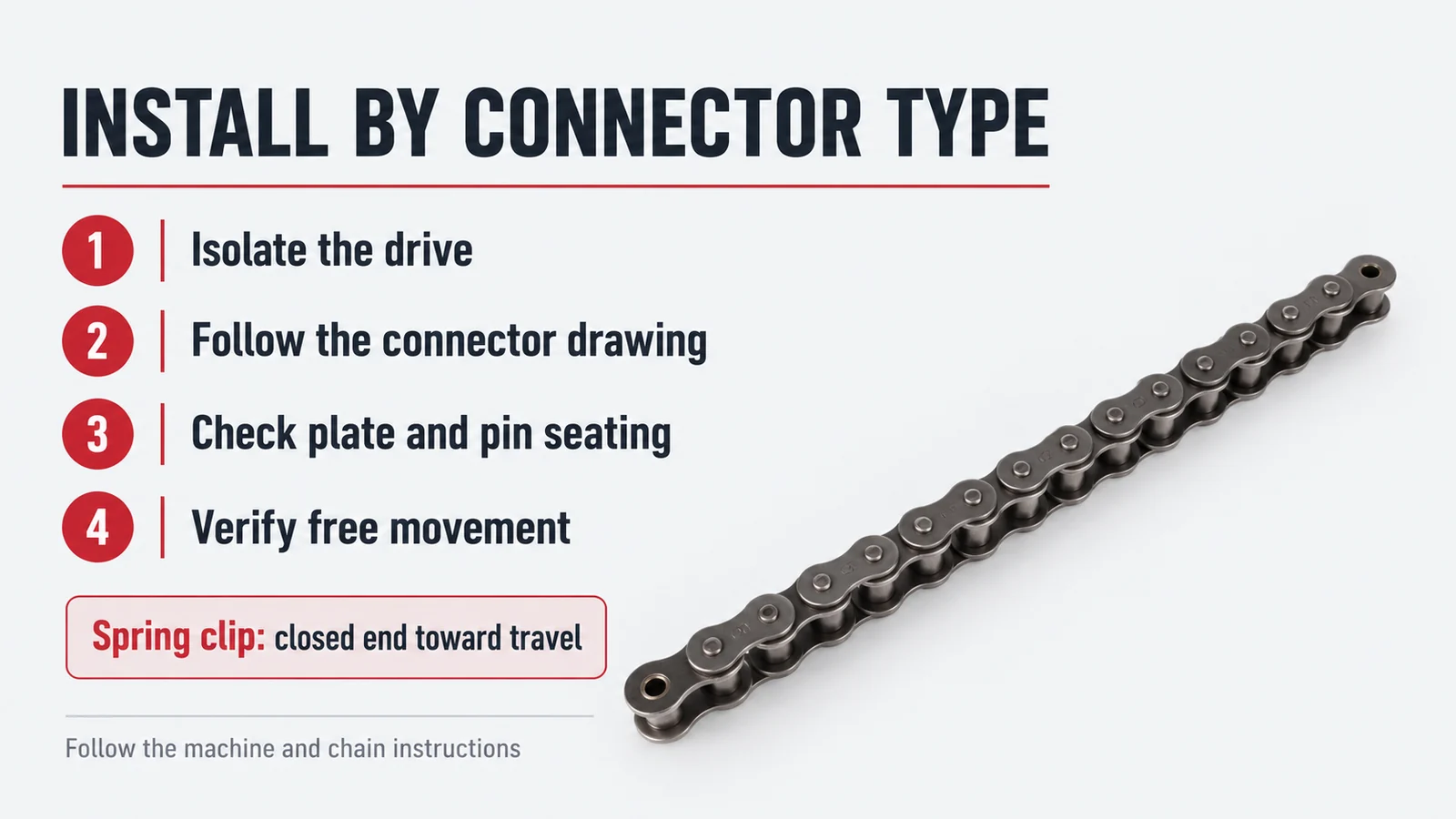
Set tension by the equipment or chain-maker method, lubricate as specified, and run a slow controlled test. Stop for clicking, grinding, vibration, a twisted chain, a loose clip or unusual movement. Recheck alignment and tension after the initial run.
How should riveted and cottered links be installed?
Treat them as different procedures. A riveted link normally uses a press-fit cover plate and riveted or peened pin ends; a cottered link uses cotters or pins. Do not apply spring-clip steps to either design.
Use the connector drawing, approved tools and a qualified maintenance procedure. Verify plate seating, pin ends and fastening against the drawing, and check for damage. If the drawing or approved tooling is unavailable, stop and seek qualified maintenance support. If the equipment uses an engineering-class chain, confirm the correct connector family first.
When should the master link or chain be replaced?
Replace a link when its plates or pins are damaged, a pin is loose, the cover plate does not sit correctly, the clip or cotter is missing, displaced or distorted, or corrosion has weakened the assembly. Do not return an incorrectly assembled connector to service.
Look beyond the connector when the chain has measurable elongation, tight joints, damaged rollers, or sprockets with visibly worn teeth. Use the measurement guide to document chain condition and the #40 versus #41 comparison before replacing a size that was identified from an old part. There is no universal elongation percentage in this guide; the equipment manual, chain maker or qualified maintenance plan should define the rejection point.
If the drive jumps, binds, runs noisily or wears repeatedly, inspect alignment, sprocket wear, tension, lubrication, contamination and chain family instead of replacing parts by symptom alone.
What should a master-link RFQ include?
Send one specification package so quotes can be compared on the same basis:
- Chain manufacturer and number, standard, series and size.
- Pitch, roller diameter, inner width, strand count and any drawing-confirmed pin or plate dimensions.
- Required connection style, plus the drawing or photos that show the chain ends and existing connector.
- Machine or equipment model, application, environment, speed and any known duty conditions.
- Quantity, required documentation, inspection needs and requested delivery date.
- Any uncertainty about chain length, odd-link arrangement or offset-link use.
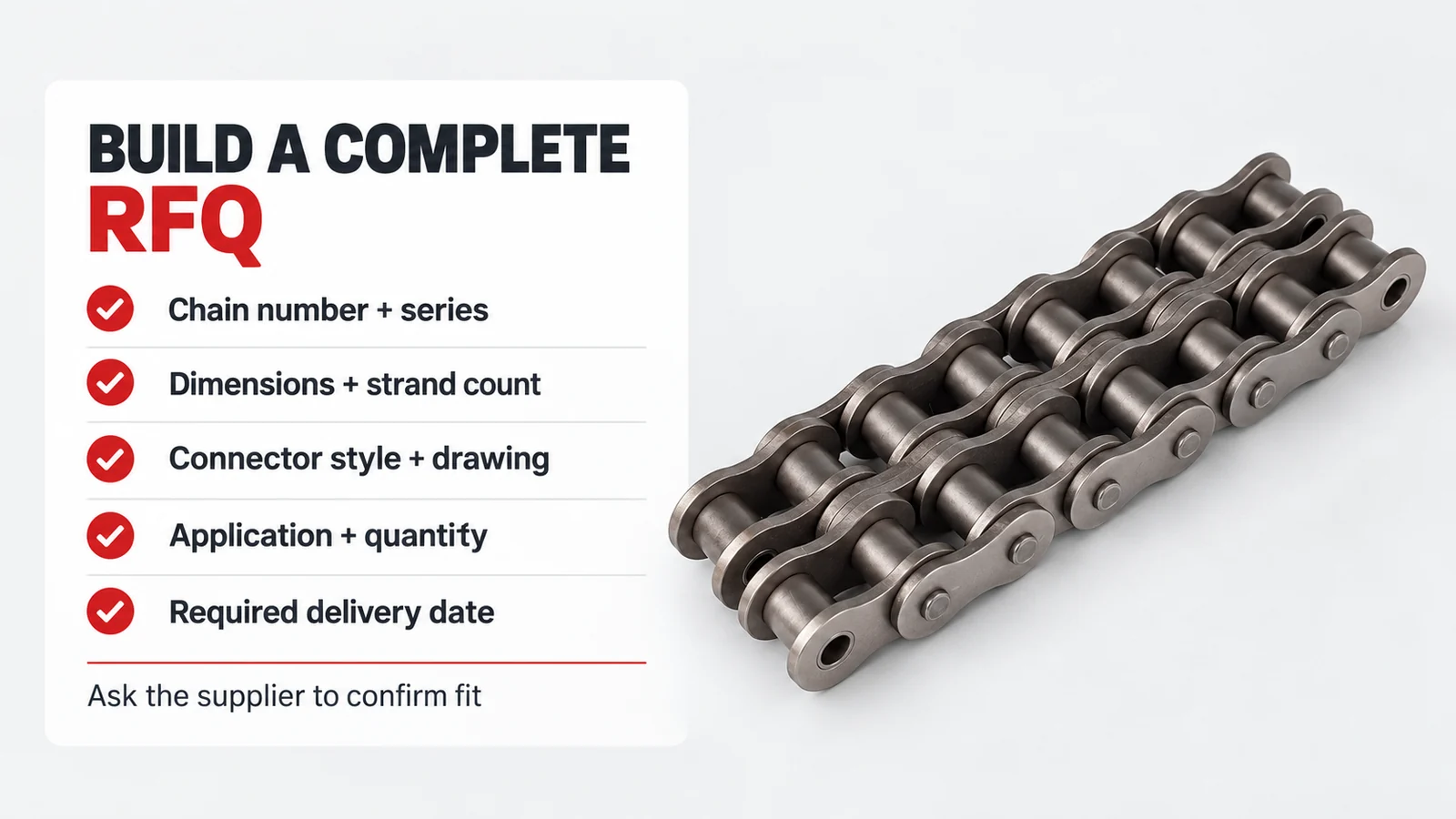
Ask each supplier to identify the connector, chain series, review dimensions and any deviation from the drawing. Compare quotations on that same specification and request confirmation rather than relying on “compatible” as a standalone claim.
For a master link roller chain replacement, send the chain number or drawing, dimensions, strand count, connection style, application and quantity through Universal Chains’ contact page for fit review.