Roller Chain Attachments: Types, Spacing, and Selection
Quick Answer: Choose roller chain attachments by confirming the chain family, mounting shape, repeat spacing and installed direction, then checking dimensions, operating load and sprocket clearance against a drawing. An attachment code alone cannot establish fit. Universal Chains lists metric conveyor chains with attachments in its M series and high attachment-plate chains in its MT series. Confirm each family against its own drawing; an M or MT designation does not establish ANSI A1/K1 compatibility. Send the application details and layout with your inquiry before selecting a model.
For buyers and distributors, the goal is a request for quotation (RFQ) that suppliers can answer on the same basis. Start with a chain number, drawing or replacement sample information. This guide explains how to specify roller chain attachments and identify the checks that require supplier confirmation.
What do roller chain attachments need to carry or move?
Attachments connect a moving chain to slats, fixtures, scrapers or other conveying parts. A slat is a carrying strip or platform. Define what that mounted part must do: support a product, push material or hold an item in position. The conveyor-chain applications guide gives broader task examples if the conveying arrangement is still undecided.
Record the product size and weight, the proposed mounting surface and how material enters and leaves the conveyor. Include a sketch showing whether one chain or parallel chains support the fixture. These details give the supplier an application to assess rather than an isolated attachment name.
For a replacement, keep the existing chain identification and attachment measurements together. Photograph the mounting face and the complete fixture, but use a dimensioned drawing to establish fit; a photograph does not establish hole sizes or plate thickness. Flag any measurements you cannot confirm.
Then identify the base construction. Browse the conveyor-chain category by family; if several constructions appear plausible, compare the types of metal conveyor chains before requesting a specific model. Roller chain attachments describe an interface, not a complete conveyor design.
Which attachment type matches the mounting task?
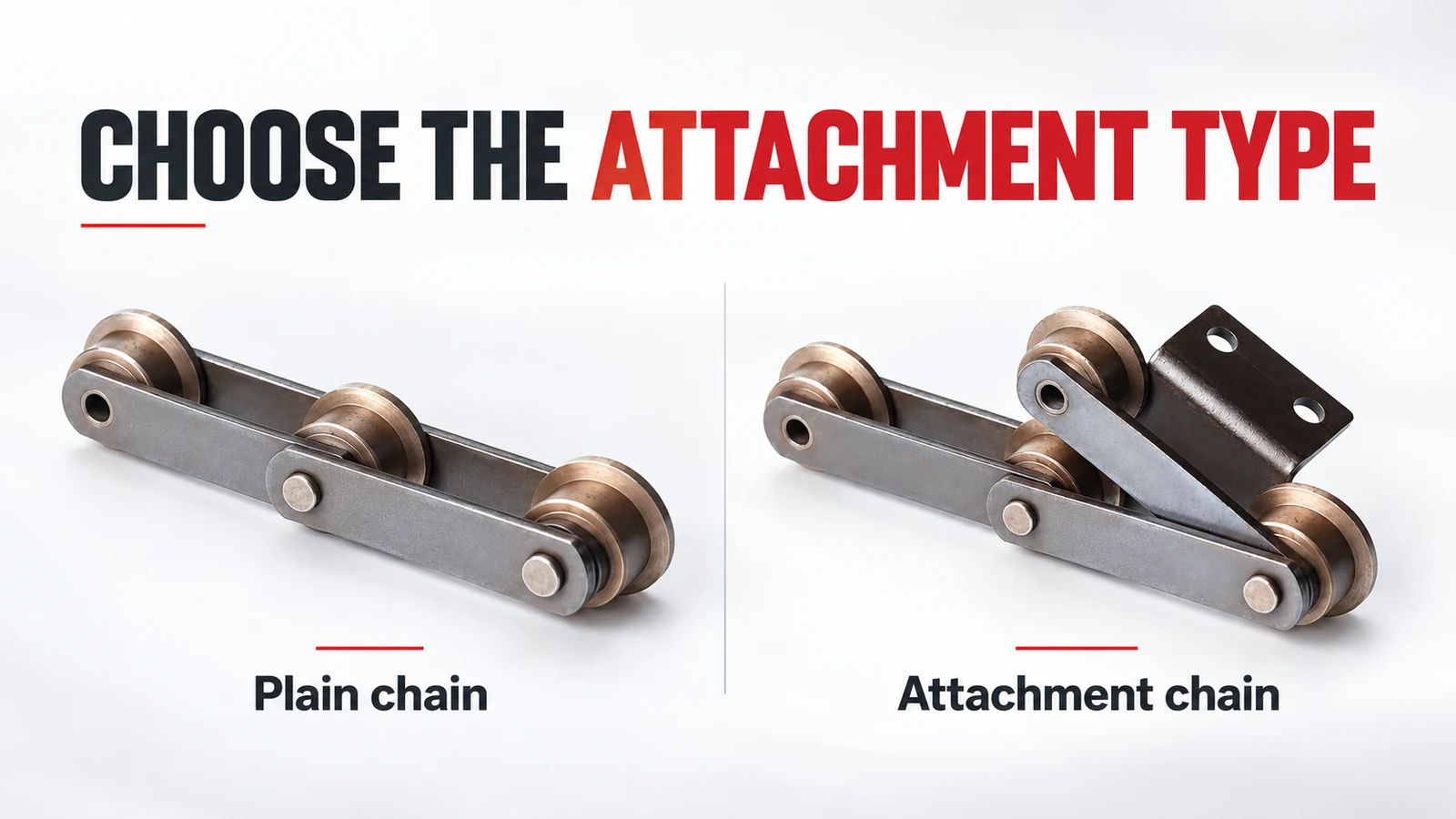
Choose the mounting face before choosing the code. Does the fixture need a bent tab, an upright plate or a projecting pin? The table below follows the naming used in U.S. Tsubaki’s attachment-chain selection guide. It illustrates that maker’s convention, not confirmed Universal product availability.
| Style in this convention | Geometry | Buyer’s drawing check |
|---|---|---|
| A1 / A-1 | Bent attachment on one side, one hole | Tab side, height and hole position |
| K1 / K-1 | Bent attachments on both sides, one hole per attachment | Mounting width and hole alignment |
| SA1 / SA-1 | Straight attachment on one side, one hole | Upright mounting face and clearance |
| SK1 / SK-1 | Straight attachments on both sides, one hole per attachment | Plate spacing and fixture width |
| Extended pin | Pin projects beyond the chain | Projection, diameter and fixing arrangement |
When comparing roller chain K1 attachments, request the series drawing rather than assuming the code defines the entire part. Renold’s conveyor terminology also uses K attachments, with its own descriptions of sides and hole arrangements. The letter and suffix need their manufacturer and series context.
Universal’s M-series conveyor chain with attachments belongs to its metric conveyor range and is described as solid-pin construction. Its MT-series conveyor chain uses a high attachment plate. Investigate these as distinct families; neither description establishes A1/K1 dimensions or a particular attachment load rating.
If the proposed fixing passes through a chain pin, investigate hollow-pin conveyor chain. If the layout calls for material to ride on rollers, top-roller conveyor chain presents a different construction to review. For a side-roller layout, check the side-roller conveyor-chain family. Confirm the construction before specifying roller chain attachments for it.
How should you specify spacing, direction and chain series?
A roller chain with attachments needs both a base-chain specification and an attachment layout. Pitch means the distance between adjacent pin centers. Record it alongside the chain standard, series and size. For a confirmed ANSI base chain, the ANSI roller-chain dimensions guide provides background for checking roller diameter and inner width; the attachment drawing remains a separate requirement.
Use these layout fields in order:
- Base chain: standard, series, size, pitch, roller diameter and inner width.
- Mounting geometry: attachment shape, plate thickness, height, hole diameter and hole-center distances, or extended-pin dimensions.
- Repeat interval: number of pitches between equivalent attachment positions, plus physical center distance.
- Side and direction: travel arrow, left/right viewed along travel, mounting face and any mirrored arrangement.
- Link position and length: intended attachment links, overall pitch count and connecting-link arrangement for supplier confirmation.
For roller chain attachments repeating every n pitches, the center interval is n × p, where p is the confirmed chain pitch. Measure between corresponding attachment points. Saying “every few links” leaves the supplier to guess both the interval and the reference point.
As a hypothetical inquiry, a buyer could write: “Metric M-family candidate, pitch p to be confirmed; attachment repeat every four pitches; center interval 4p; mounting side and travel arrow shown on the sketch.” The supplier must confirm whether this pattern can be built and mark the actual attachment links on its drawing.
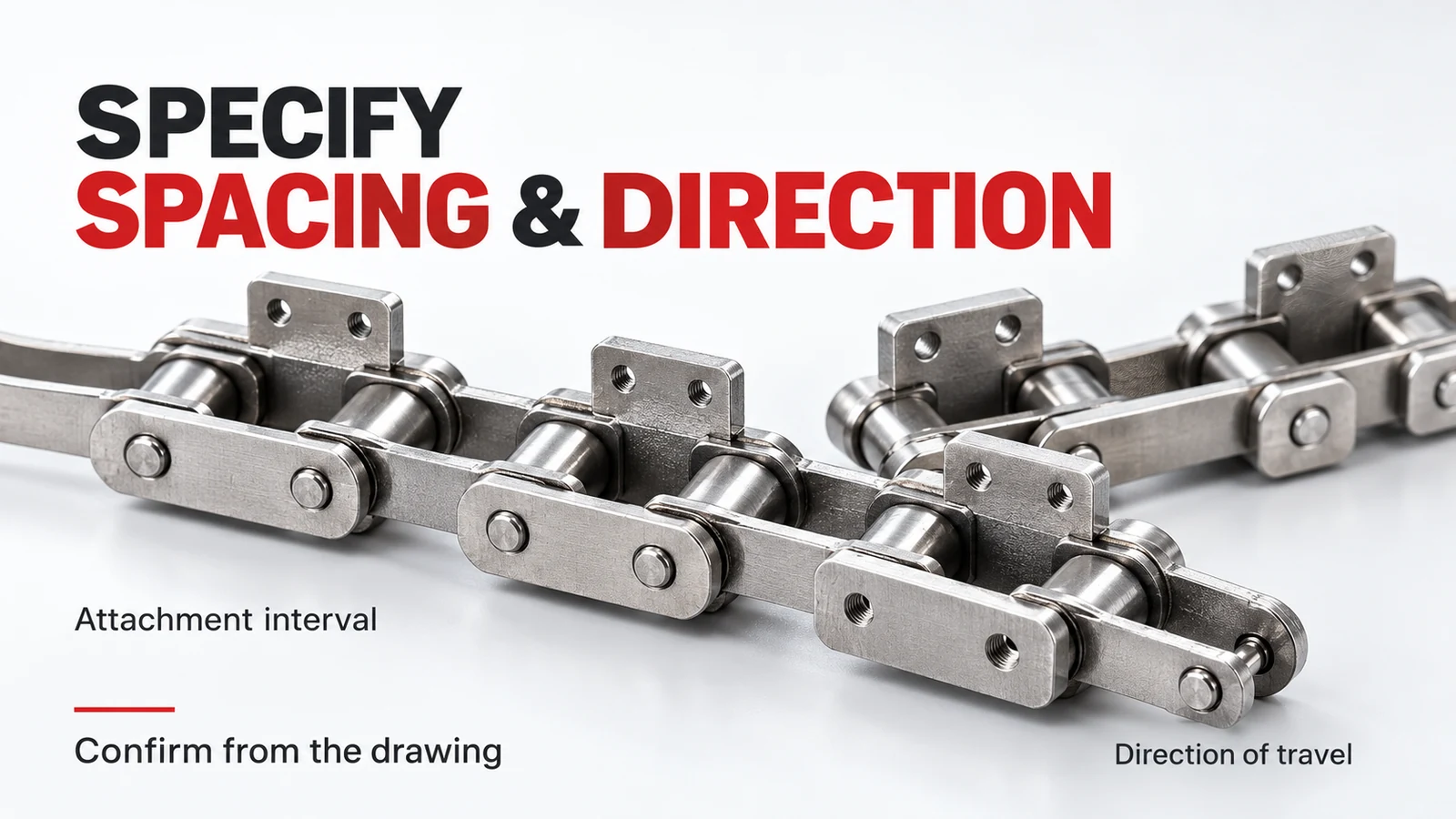
For parallel chains, draw both patterns from the same starting reference. State whether the attachments face inward, outward or in another arrangement. Check that corresponding fixture positions line up; matching repeat intervals alone do not establish their starting alignment.
What changes with double-pitch attachment chains?
Tsubaki’s paired single- and double-pitch sizes illustrate twice the distance between adjacent pins. Confirm the actual pitch for your selected family.
Specify the base family when ordering double pitch roller chain attachments. Confirm the actual pitch, roller type and diameter, attachment pattern and matching sprocket. Do not transfer an attachment drawing from a single-pitch chain because the code looks familiar.
Universal lists a double-pitch transmission chain in its A series. That separate listing does not confirm an attachment configuration. Request the drawing and availability for the exact chain you need.
What fit, load and sprocket checks come before ordering?
Dimensional fit and load suitability are separate checks. Roller chain attachments can match a fixture’s holes while still requiring review of the forces on the plate, pin and chain.
Provide conveyed weight, fixture and attachment weight, support arrangement, speed, starts and stops, shock conditions and incline. For parallel chains, describe the load position and ask how load sharing should be assessed. Working load is the allowable operating load for the stated conditions; breaking load is not an operating allowance. Renold’s conveyor-chain designer guide explains this distinction and the application inputs needed for selection. Ask for both chain and attachment load confirmation for your layout.
Check roller chain attachments through the complete path, including the sprocket, the toothed wheel that engages the chain. Supply existing sprocket details and request confirmation of pitch, roller engagement, tooth profile and clearance as the fixture travels around it. Include fasteners, projections, guides, frame members and the return run in the review. A straight-run sketch cannot show the complete attachment sweep.
Record temperature, moisture, washdown, dust and corrosive exposure. For wood handling, the wood-processing conveyor-chain selection guide provides further application questions. Use the chain lubrication guide to prepare maintenance questions, then confirm the selected chain’s requirements with the supplier.
Hold the order if the drawing, load assessment or sprocket fit remains unresolved. Request clarification rather than treating the base-chain number as approval of the assembled conveyor.
What belongs in an attachment-chain RFQ?
Send one specification package for roller chain attachments containing:
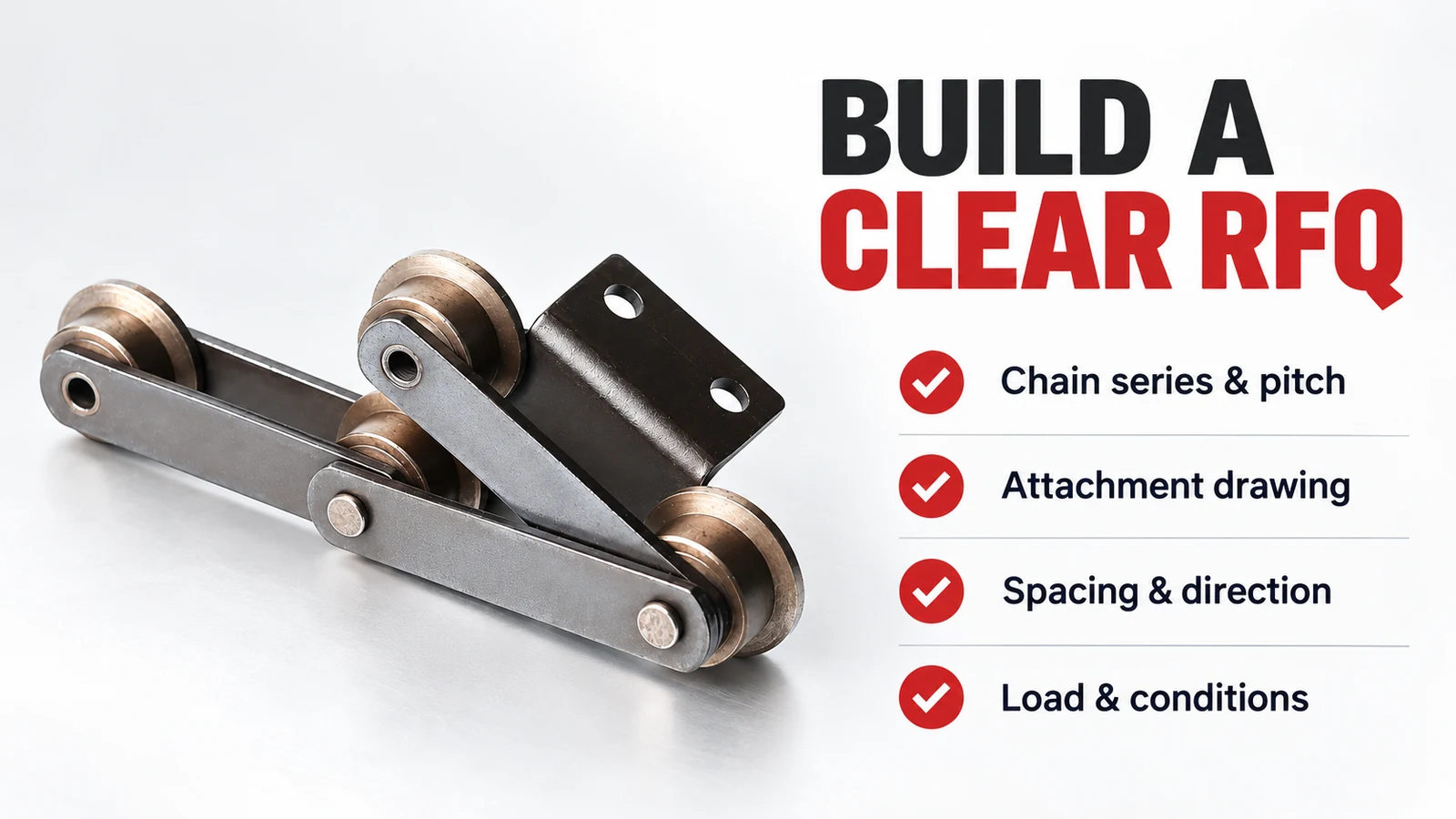
- Chain number, standard, series and existing machine reference; include photos and available drawings.
- Attachment geometry, mounting dimensions, material requirements and drawing revision.
- Repeat spacing in pitches and physical distance, travel direction, side and link positions.
- Chain length, connecting arrangement, quantity and parallel-chain layout where applicable.
- Product and fixture weights, speed, duty, supports, environment and sprocket details.
- Required delivery date and requested drawing, sample or dimensional-inspection confirmation.
Before sending the RFQ, check that another person can locate each attachment from the drawing without a verbal explanation. If the starting point, viewing direction or fixing dimensions are ambiguous, revise the package. This is a practical completion check for specifying roller chain attachments.
Ask each supplier to identify deviations and state what its quotation includes. Compare roller chain attachments against the same drawing revision, quantity and confirmation requirements before comparing prices. Request a delivery commitment for that specification rather than assuming one from a product page.
Once the specification is accepted, use the installation and maintenance guide as background alongside the equipment and chain-maker instructions.
For a Universal M-series inquiry, send your chain number or photos, mounting drawing, spacing layout and operating details through the M-series product inquiry page. Ask which model and attachment arrangement can be confirmed against that package.