Roller Chain Manufacturers in Europe: Sourcing Guide
Quick Answer: Screen roller chain manufacturers in Europe in five steps: confirm the exact chain family and dimensions; establish whether the seller is a factory, brand owner, distributor or directory; verify production origin rather than office address; compare standards and the complete assembly; then obtain destination-specific stock, lead-time and landed-cost evidence. A credible supplier names its factory, shows product-specific capability and quotes the same technical and commercial scope. Use that evidence to keep or remove a regional supplier from the comparison.
For buyers searching roller chain manufacturers in Europe or roller chain suppliers Europe, the phrase hides several buying situations: a standard drive chain for a production line, a replacement for older equipment, a modified chain with attachments, repeat supply for a distributor or an OEM project. Start by narrowing the object being sourced, using this roller-chain product range and the broader drive-chain categories as navigation aids. A regional search is useful only after the chain and buying job are clear.
What should a European roller-chain sourcing brief define?
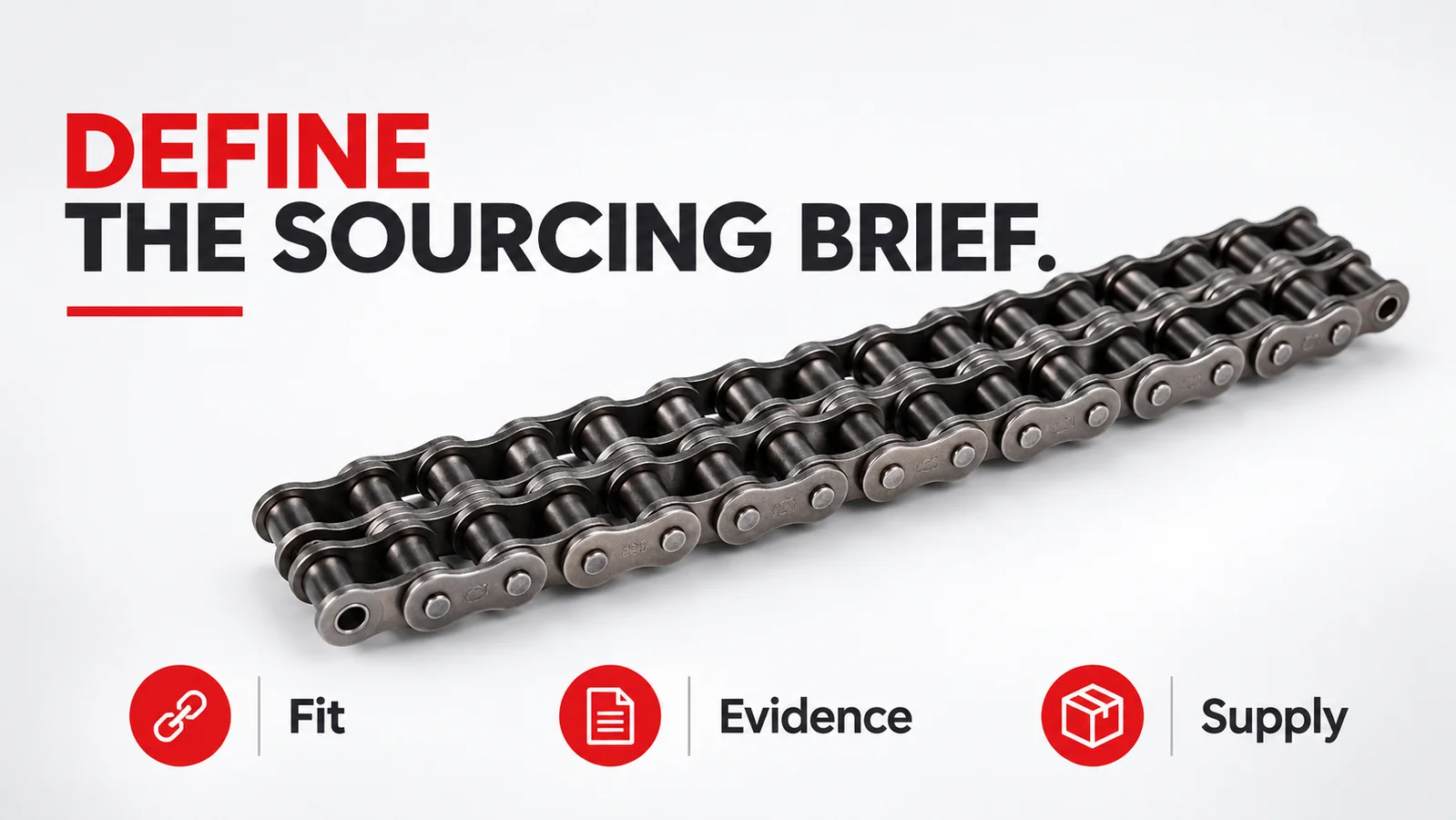
Write the brief around the installed assembly, not around a generic phrase such as “standard chain.” Record the chain number or drawing, pitch, roller diameter, inner width, strand count, overall length and joining-link type. Add the sprockets, shaft centres, attachments, operating load, speed, duty cycle, temperature, contamination and lubrication. These details determine whether two quotations describe the same job.
If the chain number is unknown, use a structured roller-chain measurement guide and note how the measurement was taken. Identify whether the chain is a short-pitch precision roller chain, a double-pitch design or another chain class. The guide to roller-chain types explains why visually similar chains can have different dimensions and intended duties.
Add commercial scope to the same document: annual demand, first-order quantity, required delivery window, destination postcode and country, target Incoterm, currency and required technical documents. For a replacement, include photographs and the equipment make and model where available. For an OEM project, state the revision of the drawing and the approval process.
This brief lets a European specialist and an overseas factory quote the same problem. A shortlist assembled before those details exist tends to compare sales language rather than supply capability.
How can buyers tell a manufacturer from a brand or distributor?
Put every candidate into one of four roles. A manufacturer controls relevant production operations for the quoted product. A brand owner may design, specify and warrant products while using contract production. A distributor or stockholder buys and resells, sometimes with application support. A directory or marketplace lists other companies and may verify very little.
The role itself is not a disqualification. A strong distributor can hold useful regional stock and provide engineering support. The problem arises when its listing is read as factory evidence. Ask for the legal entity that will issue the quotation, the production address for the proposed series, the production processes performed there and the responsible quality contact.
Eurobalt is a useful illustration of why product scope matters. Its chain page describes a chain manufacturing company, with anchor, round-link, lifting, fishing and conveyor products. Those claims do not establish a short-pitch roller-chain factory. The same discipline applies in reverse: a generic directory listing cannot prove that its members manufacture roller chains.
KettenWulf offers stronger role evidence. It describes itself as a manufacturer of conveyor chains, drive chains and sprockets and shows production processes covering machining, heat treatment, welding, stamping and sprocket processing. iwis lists roller-chain ranges built to DIN and ANSI standards. These examples do not prove that every series comes from the same plant or is stocked locally. For related context, Universal’s European chain overview is a useful follow-up.
Which European standards, materials and fit details should you compare?
A phrase such as “DIN compatible” is too vague to release an order. Require the standard family, series or chain number, dimensions, tolerance class and applicable revision. iwis, for example, separates ISO 606 B-series filters from ANSI ranges and also lists simplex, duplex and triplex assemblies. Universal’s precision roller-chain category similarly separates A, B and special series.
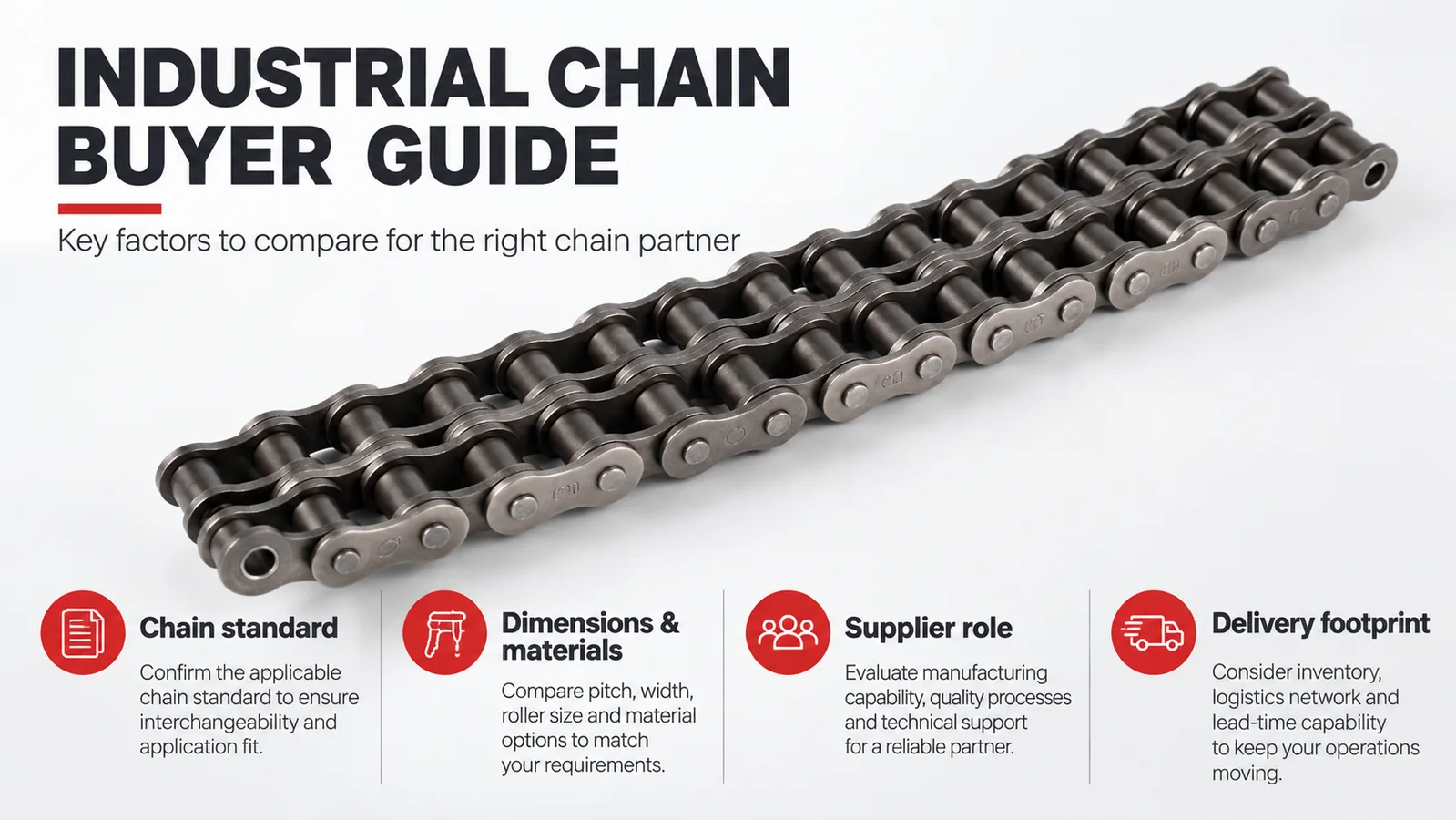
When a machine specifies a B-series chain code such as 08B or 12B, keep that designation attached to the replacement request. ANSI equipment may use numbers such as 40 or 60 instead. The unit system and dimensions form part of the specification, and a similar pitch or familiar-looking roller does not prove interchangeability. Universal’s A-series product page and B-series product page provide places to start, while the ANSI and metric comparison explains why the standard family must stay attached to the replacement request.
Then calculate the complete interface. Confirm the dimensions required for an ANSI chain, the single- versus multi-strand construction and the sprocket tooth profile. A chain that fits the pitch but not the inner width, roller diameter or sprocket can still fail.
Material and finish need the same product-specific treatment. iwis distinguishes standard, corrosion-resistant, stainless-steel, maintenance-free and high-performance roller chains, with selection dependent on load, speed, environment, lubrication and service life. Establish which base material, heat treatment and surface finish apply to the exact model. For difficult lubrication, compare self-lubricating roller chains. For wet or corrosive conditions, review the corrosion-resistant range or stainless-steel chain range and ask for environment-specific evidence. If a higher-strength option is proposed, compare the high-strength short-pitch range and ask which wear, fatigue or strength requirement changes.
Longer-pitch designs belong in a separate comparison. Use the double-pitch transmission chain range when the machine design calls for that family, rather than applying a short-pitch selection rule. The older comprehensive roller-chain guide can help orient a new buyer without replacing the equipment maker’s specification.
What does a European delivery footprint actually tell you?
It may tell you where a company is registered, where its sales team works, where a warehouse is located or where a particular plant operates. Those are four different facts. Ask for the country of origin by product line, the ship-from location for your quantity, the party that owns the stock and the destination-specific lead-time basis.
Tsubaki’s 2025 German manufacturing announcement shows why scope matters. It describes the acquisition of Karl Jungbluth and a Bad Hersfeld manufacturing base for tailored conveyor-chain solutions. That is valuable evidence for that announced scope. It does not establish German manufacturing or local stock for every Tsubaki roller-chain model.
KettenWulf’s locations page performs a similar check. It lists a German company address alongside locations in China, Austria and several other countries, but the page does not label every address as a plant. A flag icon or country heading cannot answer production-origin questions by itself.
At quotation stage, require the exact ship-from city, Incoterm, named place, lead time measured from purchase order, partial-delivery plan and validity. For imported supply, add freight, insurance, customs and tax responsibilities to the landed-cost comparison. No generic guide can supply current duty or lead-time values because the product, origin, destination and date all affect them.
Which questions separate a reliable supplier from a directory listing?
Ask for the manufacturer’s legal name and site address for the proposed chain. Request the exact series, dimensions, drawings, material specification and joining components. Then ask which production steps the site performs, how it controls heat treatment and surface finishing, and how traceability works from incoming material to finished chain.
Documents should match the decision. A quality-system certificate is useful, but check its holder, scope, site and validity. Ask for the relevant specification sheet, inspection plan, sample or first-article process, material documentation where required, and a change-notification rule for repeat orders. For a safety-sensitive application, the equipment and chain makers should review the complete design rather than treating one available strength figure as design approval.
For odd-length replacements, understand the offset-link construction and ask for the joining link in the quotation. Confirm whether the quoted fitted length includes the connector. Ask who supplies spares, which sprocket dimensions must be checked and what evidence supports the stated installation and maintenance method. The installation and maintenance guide is useful after supplier selection, not a substitute for an approved machine procedure.
When should you compare European supply with global factory-direct options?
Europe should often stay in the first comparison when downtime makes response speed critical, an engineer needs to assess a difficult application, a procurement policy requires domestic or regional origin, or a project needs frequent small design iterations. Those benefits can justify a higher purchase price when the supplier documents them and the total cost still supports the application.
Compare a global factory-direct route when demand is repeatable, the drawing and quality standard are clear, and your team can manage international logistics, customs and incoming inspection. Lower unit price alone is not enough. Request factory evidence, product-specific standards, inspection plans, packaging, joining hardware, lead-time assumptions and change control.
Universal Chains is one such global comparison. Its company profile describes a China-based manufacturer dating to 1970 that exports internationally and offers standard and application-specific chain families. That makes it relevant for a factory-direct quote, not evidence of European manufacturing or stock. Compare Universal and the European candidates on one specification and document list.
What belongs in the final sourcing comparison?
Use one line per supplier and one shared specification.
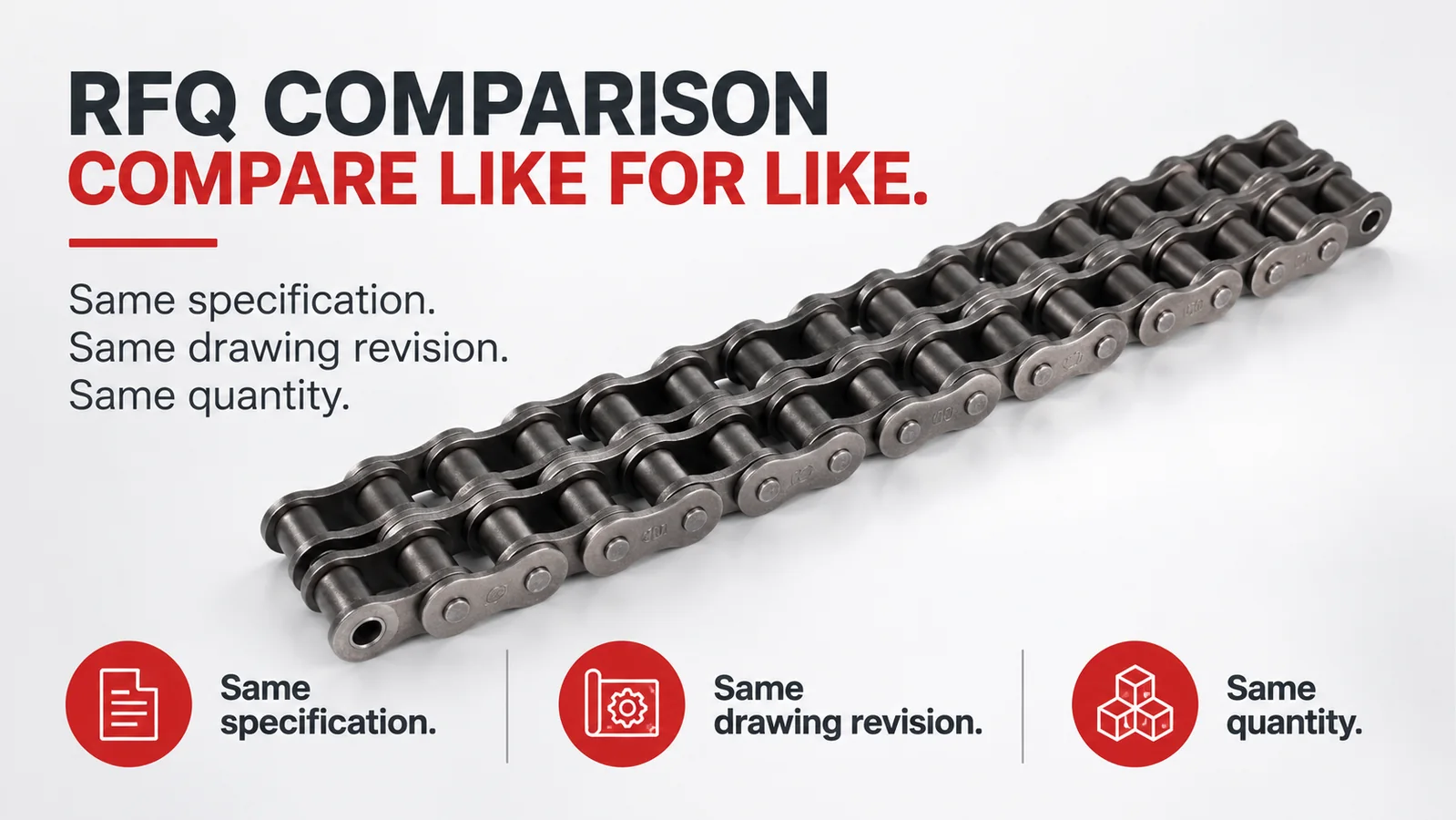
| Supplier | Role and origin | Stock and lead time | Specification and documents | Commercial basis |
|---|---|---|---|---|
| Candidate A | Factory, brand or distributor? Which site makes it? | Stock owner, origin and destination lead time | Exact model, standard, materials and inspection plan | MOQ, currency, Incoterm and validity |
| Candidate B | Same fields, verified on the quoted series | Same basis, not a regional promise | Same document set | Same basis |
| Candidate C | Same fields | Same fields | Same fields | Same fields |
Leave an unavailable field blank or mark it unverified; do not fill it with an encouraging assumption. The stronger shortlist is the one with fewer unexplained facts, not necessarily the largest list of brands.
This guide is not a complete census or ranking of roller chain manufacturers in Europe. The workbook’s directory candidate was unavailable during this review, and no current European quote, stock level, lead time or certificate scope was verified. Treat those as supplier-specific checks.
For broader background, Universal’s older roller-chain manufacturer overview can supplement your own verification. For a specific source comparison, send Universal Chains your chain number or drawing, operating duty, quantity, delivery destination and required documents. Ask for the exact model, production-origin basis and a complete RFQ response, then compare that response with your European candidates.